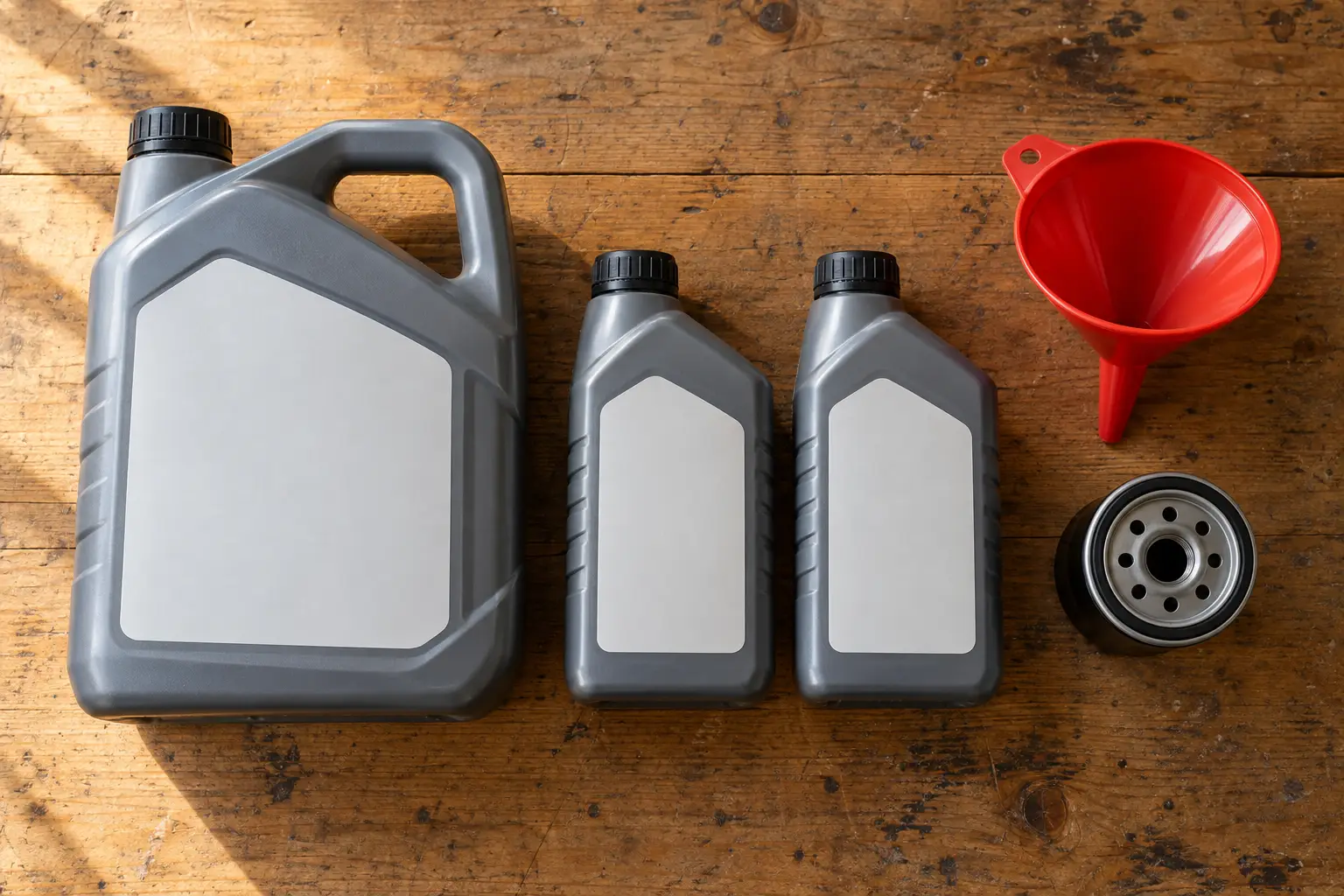
The best engine oil for a track day is still the one your handbook specifies, as a fully synthetic, approved oil with a high HTHS figure for its grade. For a tuned car, that often means moving to a slightly thicker grade within an approval your engine lists, such as a BMW going from 0W-20 to an approved 5W-30 or 5W-40.
What matters more than the brand is how you look after the oil on the day. Track driving makes it run hotter, slosh around in long corners and wear out faster, and a car that's a litre low is at more risk than one on a cheaper oil.
Start with your car's spec
Every decision in this guide sits inside the spec your manufacturer lists. Find it in the handbook or with a reg plate oil finder such as Castrol's or Shell LubeMatch, and note three things:
- The grade, such as 5W-30.
- The spec code, such as ACEA C3 or BMW Longlife-04.
- The fill capacity in litres.
Our main guide, What oil does my car need?, explains how to read those codes and why an "approved" oil is safer than one that only "meets" a spec.
One group of engines gets no leeway at all. Ford's 1.0 EcoBoost and Stellantis' 1.2 PureTech run their timing belt in the oil, and the wrong oil can break the belt down and block the oil strainer. If you track or tune one of these, use the exact spec it lists and nothing else.
What a track day does to your oil
For a standard road car doing the odd track day, the right oil doesn't change. How hard it works does:
Effect | What happens on track | What to do about it |
|---|---|---|
Heat | The oil runs much hotter during 20 minute sessions at high revs | Use a fully synthetic oil with a high HTHS figure for its grade |
Oil surge | Long, fast corners throw the oil away from the pickup in the sump | Keep the level at the full mark all day |
Wear | Additives and viscosity get used up faster than on the road | Change the oil sooner than the road interval |
A common rule of thumb in lubrication is that oil oxidises roughly twice as fast for every 10°C rise, so a hard track day can age it as much as a lot of road miles.
Should you use a thicker oil for track days?
Start with the handbook. If it lists more than one grade or spec for your engine, the option with the higher HTHS (high temperature, high shear viscosity) is the stronger choice for circuit work. HTHS measures how thick the oil stays in the hottest, tightest gaps such as the bearings. A C3 or A3/B4 oil must reach at least 3.5 mPa·s, against 2.9 for C2 and as little as 2.6 for C5 or a 0W-20, according to Liqui Moly's spec guide.
The actual HTHS figure is on the oil company's product data sheet. Two oils with the same grade and approval can differ, so for track use pick the one with the higher number.
Don't put a heavy race oil in a standard hatchback. Kwik Fit points out that oil that's too thick takes more energy to push round the engine. An oil outside the spec can also cause warranty arguments, and in a wet belt engine it could do real damage.
Owners of dedicated track cars often run thicker grades such as 10W-50 or 10W-60, usually with an oil cooler and a temperature gauge. That setup suits a modified car, and it's worth talking it through with a specialist first.
Fully synthetic or semi synthetic?
For track days, go fully synthetic. Kwik Fit says fully synthetic oil resists heat and oxidation better than semi synthetic, and most modern specs need it anyway.
Oil surge in long corners
In a long corner, the oil piles up against one side of the sump and the pump can briefly suck air. Some engines are known for it, including Toyota's GR86 engine and the Toyota units in the Lotus Elise and Exige.
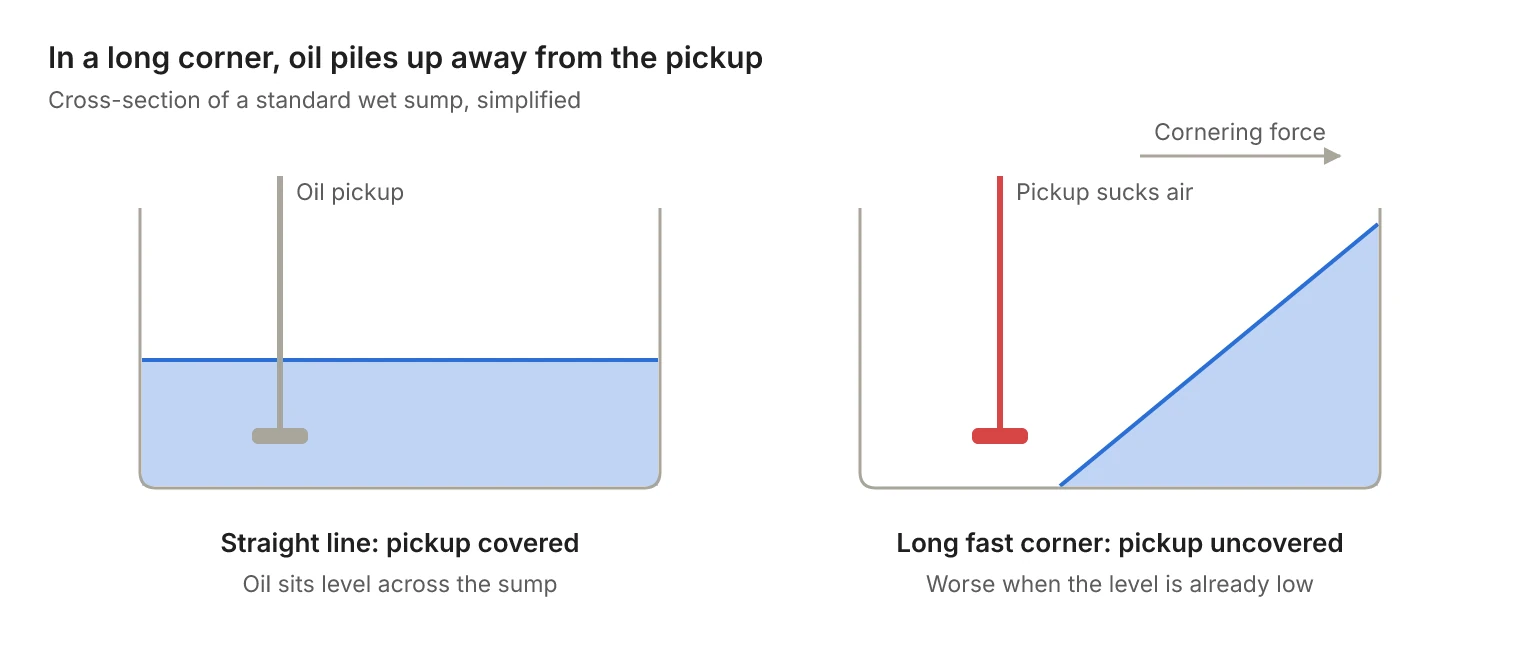
The cheapest protection is keeping the level at the full mark all day. Cars with a known problem often get a baffled sump, and your owners' club will know if yours is one of them.
Track day oil checklist
Each of these checks takes a few minutes in the paddock.
Before you go
[IMAGE: checking-engine-oil-track-day.webp] Alt text: "Checking the engine oil level in the paddock at a track day". Prompt: Photorealistic shot of a driver in a fire resistant race suit checking the engine oil on a hot hatch in a circuit paddock between sessions. Bonnet up, dipstick held up to the light, a small funnel and a plain unbranded 1 litre oil bottle on the wing. Pit garages and other track day cars softly blurred behind, overcast British weather with damp patches on the tarmac. No logos, badges, number plates or readable text. (3:2) Replace this paragraph with the image before publishing.
- Change the oil and filter first if they're close to their service interval.
- Check the level on flat ground with the engine cold and fill it to the max mark.
- Pack a litre of the correct spec oil, a funnel and some rags.
- Know your fill capacity so you top up without overfilling.
On the day
- Take the first lap gently, because oil warms up more slowly than coolant.
- Drive a cool down lap at the end of every session.
- Check the level between sessions once the car has stood on level ground for a few minutes.
- Come straight in if the oil pressure light flickers in a corner.
Afterwards
- Check the level again, since hard driving can burn more oil than usual.
- Look for a severe use or motorsport schedule in your handbook and follow it if there is one.
- If you do several track days a year, change the oil earlier than the road interval suggests.
If you only manage two things, change the oil before the event and keep it at the full mark.
Best oil for a tuned or remapped car
Often a slightly thicker oil is better, as long as it still carries an approval your engine can take. A remap raises boost, cylinder pressure and heat, so the oil works harder. UK tuners such as Awesome GTI and Mobile Eco Tuning recommend a high quality oil and shorter change intervals once a car is mapped, especially at Stage 2.
[IMAGE: tuned-car-engine-oil.webp] Alt text: "Engine bay of a tuned turbocharged car". Prompt: Photorealistic three quarter view looking down into the clean engine bay of a tuned turbocharged car, showing an aftermarket intake, silicone intercooler hoses and the oil filler cap. Moody lighting in a dark home garage with one work light. No brand logos, badges or readable text on any part. (16:9) Replace this paragraph with the image before publishing.
Stage labels vary from one tuner to the next, as Blackcircles points out. Roughly, Stage 1 is software only, while Stage 2 adds hardware such as a downpipe, intake or intercooler.
The BMW example: 0W-20 to 5W-30 or 5W-40
Newer BMW petrol engines like the B58 often leave the factory on a 0W-20 oil approved to Longlife-17 FE+, which is designed with fuel economy in mind. Once these engines are tuned, a lot of owners move to a 5W-30 or 5W-40 approved to Longlife-01 or Longlife-04.
Parts specialist FCP Euro goes further and recommends LL-01 oils over the 0W-20 spec on B-series engines for extra protection and shear resistance. Owners of tuned B58s on the Bob Is The Oil Guy forum point to LL-04 5W-30s with an HTHS of around 3.6.
BMW approval | Typical grade | Where it comes up |
|---|---|---|
Longlife-17 FE+ | 0W-20 | Factory fill on newer engines such as the B58, aimed at fuel economy |
Longlife-01 | 5W-30, 5W-40 | A common choice for tuned engines, and FCP Euro's pick for B-series engines |
Longlife-04 | 5W-30 | Owners of tuned B58s point to LL-04 oils with an HTHS around 3.6 |
Longlife-22 FE++ | 0W-12 | Listed for later B58 versions, so check before switching |
The gain comes from how thick the oil stays when hot. The cold number on the label barely matters in a British winter, because both 0W and 5W oils pass their cold tests at -30°C or below. What changes is the HTHS, which climbs from the 2.6 minimum of a 0W-20 to 3.5 or more on these oils. A thicker hot film suits an engine making more power than standard.
Later B58 versions list different approvals, including a 0W-12, so check what your exact engine allows before switching.
Rules of thumb for tuned engines
- Ask your tuner which grade and spec their map was developed and tested on.
- Stay within an approval your engine lists, and pick the product with the higher HTHS figure.
- On a turbocharged direct injection petrol, choose an oil carrying API SP or ACEA C6, because both include tests against low speed pre-ignition.
- Shorten your oil change interval, and shorten it again if the car also does track days.
- Never go outside the spec on a wet belt engine, tuned or not.
Low speed pre-ignition is worth taking seriously on a tuned turbo engine. Q8Oils describes it as uncontrolled combustion that can cause catastrophic engine damage, and API SP was brought in during 2020 partly to help prevent it. It tends to happen under high load at low revs, so a map that adds boost low down makes the right oil more important.
Frequently Asked Questions
What is the best oil for track days?
The one your handbook specifies, as a fully synthetic, approved product with a high HTHS figure for its grade. Then keep it at the full mark all day.
Do I need a race oil for a track day?
Not in a standard road car. Race oils and very thick grades are for modified cars with oil coolers, and an oil outside your spec can cause warranty problems.
How often should I change my oil if I do track days?
Sooner than the road interval. Follow any severe use schedule in your handbook, and change the oil before an event if it's near its service date.
What oil should I use in a remapped car?
Stick to an approval your engine lists, but pick the product with the higher HTHS figure, and ask your tuner what their map was tested on. On a BMW that left the factory on 0W-20, that often means a Longlife-01 or Longlife-04 5W-30 or 5W-40.
Can I use 5W-40 instead of 0W-20?
Only if your handbook lists 5W-40 or an approval that 5W-40 oils carry for your engine. Many BMW petrol engines allow Longlife-01 or Longlife-04 oils in those grades, but some newer engines don't.