Your car needs the oil its manufacturer specifies: a viscosity grade such as 5W-30, plus a specification code such as ACEA C3 or VW 504 00. Both are in your handbook, or you can get them in a minute by typing your number plate into a free oil finder. Buy any brand that carries that exact spec and you're covered.
That answer holds whether you drive to work or drive flat out round Brands Hatch. A track day doesn't change which oil is right, but it does push that oil much harder. It runs hotter, sloshes around in long corners and gets used up faster, so how you look after it matters more than whose name is on the bottle.
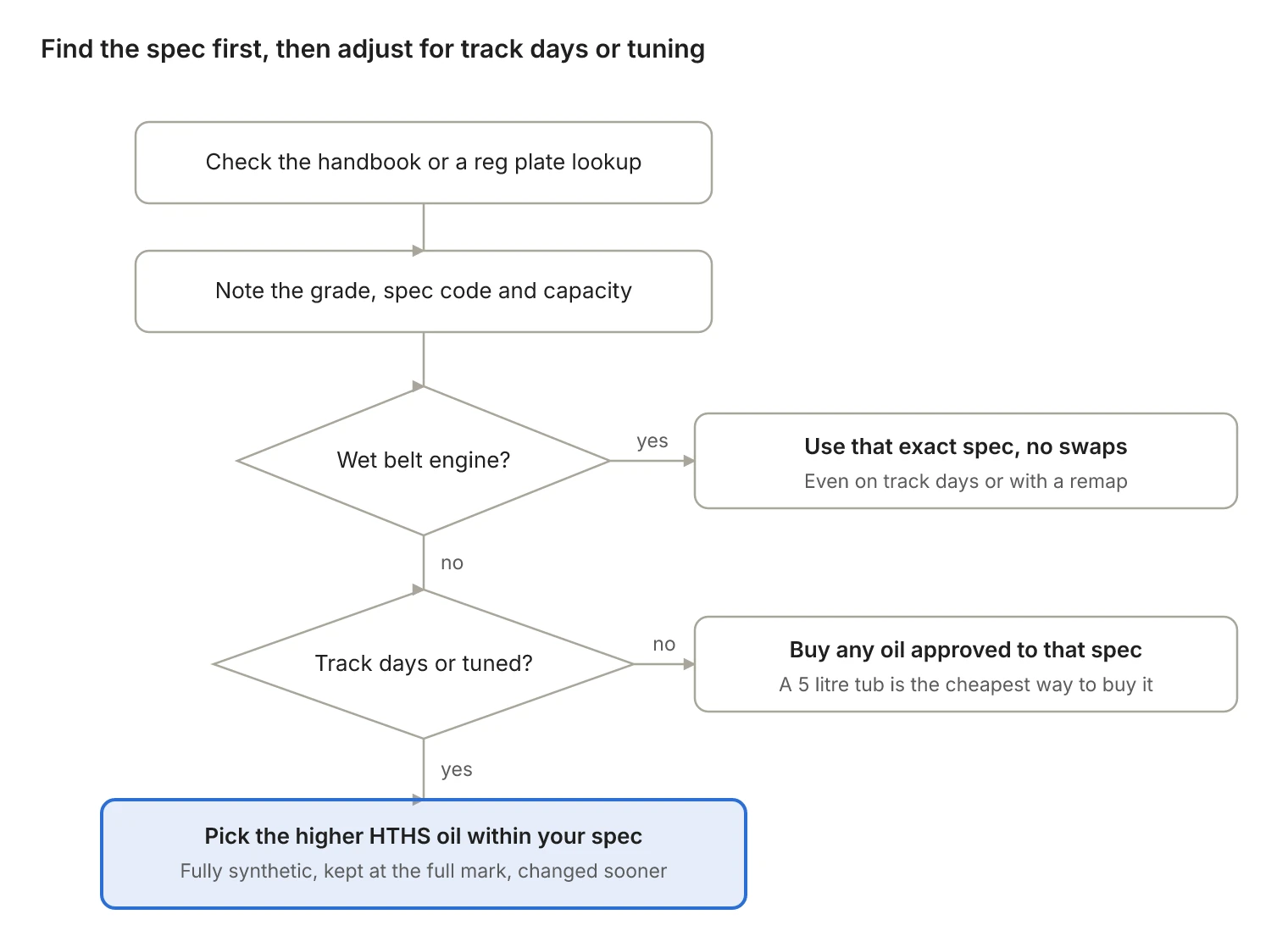
If your car has a wet belt engine, use the exact spec it lists, even for track days or after a remap.
How to find the right oil for your car
The quickest route is a free reg plate oil finder. Most of them work straight from a UK number plate:
Oil finder | Look up by | Also shows |
|---|---|---|
Reg, or make, model and year | Castrol oils that suit your car | |
Reg, or make and model | How often the oil should be changed | |
Reg | Suitable oils, plus booking an oil change | |
Reg, or make and model | Cars, classics, motorbikes, vans and HGVs | |
Your vehicle | The spec and roughly how much a full change needs |
Each brand's tool only recommends its own products. Use it to find the spec, then buy wherever is cheapest.
Your owner's handbook is still the final word. The maintenance or technical data pages should give you three things:
- The grade, such as 5W-30.
- The spec code, such as ACEA C3, VW 504 00 or Ford WSS-M2C913-D.
- The oil capacity in litres, usually quoted with a filter change.
If the handbook has gone missing, your last service invoice should name the oil that went in. A main dealer's parts desk can also look up the spec from your reg.
Service stickers and old booklets can be out of date, because car makers sometimes change the oil an engine needs years after launch. Stellantis did exactly that with its 1.2 PureTech petrol engine, which we cover further down.
How to read an oil bottle: 0W-20, 0W-30, 5W-30 and the rest
An oil grade such as 5W-30 is two ratings in one, both set by the SAE J300 standard.
- The number before the W (for winter) is the cold rating, and a lower number flows more easily on a cold start.
- The number after the dash is the hot rating, measured at 100°C, close to where a warm engine runs.
Under J300, the three grades people search for most compare like this:
Grade | Cold cranking test | Hot viscosity at 100°C | Minimum HTHS at 150°C |
|---|---|---|---|
0W-20 | Passes at -35°C | 5.6 to under 9.3 cSt | 2.6 mPa·s |
0W-30 | Passes at -35°C | 9.3 to under 12.5 cSt | 2.9 mPa·s |
5W-30 | Passes at -30°C | 9.3 to under 12.5 cSt | 2.9 mPa·s |
Source: SAE J300 limits via Anton Paar
HTHS stands for high temperature, high shear. It measures how thick the oil stays in the tightest, hottest gaps in the engine, such as the bearings. It's the closest a data sheet gets to telling you how well an oil protects the engine, and it matters more on track.
5W-30 vs 0W-30
Once the engine is warm, there's very little between them. Both are 30 grades, so they share the same hot viscosity band and the same HTHS minimum. The 0W just passes its cold test 5°C lower.
Both test temperatures are far colder than a normal British winter. Even the -23°C recorded at Braemar, the UK's coldest reading since 1995, is warmer than either test.
Each grade also covers a range, so one brand's 0W-30 can run slightly thicker when hot than another brand's 5W-30. Swapping between them is usually fine, but only when the replacement carries the spec your handbook lists.
0W-20 is a thinner oil
0W-20 has a lower hot viscosity band and a lower HTHS floor, 2.6 against 2.9. Engines that use it are designed around it to cut friction and fuel use.
When Volkswagen brought in its 0W-20 specs, VW 508 00 and 509 00, oil maker Fuchs said they would save at least 4% fuel. Fuchs also pointed out that these specs are not backwards compatible with older VW ones. Millers Oils adds that the oils are dyed so mechanics can spot them and keep them out of older engines.
Toyota and Honda have gone thinner again, with 0W-16 in some engines. Only use these thinner oils if your car lists them, rather than as a way to save fuel in a car that asks for a 30 grade.
Why the spec code matters more than the brand
Two bottles can both say 5W-30 and still be wrong for each other's engines. The spec code tells you what the oil was built and tested to do, and it comes in two types.
ACEA codes are European industry standards. A is for petrol, B for diesel, and C for lower ash oils that are kinder to exhaust filters. Older high ash oils such as A3/B4 can block a diesel particulate filter, which is why the C family exists.
Car maker approvals come from the manufacturer's own testing. Examples include VW 504 00, BMW Longlife-04, MB 229.51, Ford WSS-M2C913-D and Stellantis FPW 9.55535/03. If your handbook lists one of these, it outranks the ACEA code.
A higher ACEA number doesn't mean a better oil. C5 and C6 are designed for a thinner hot film than C3, so they aren't a drop-in replacement:
ACEA code | Minimum HTHS | What it's for |
|---|---|---|
C2 | 2.9 mPa·s | Fuel saving oils that are safe with particulate filters |
C3 | 3.5 mPa·s | Mid ash oils with a thicker hot film, performing like A3/B4 |
C5 | 2.6 to 2.9 mPa·s | Maximum fuel economy, only in engines designed for it |
C6 | 2.6 to 2.9 mPa·s | Builds on C5 with extra tests for low speed pre-ignition and turbo protection |
Source: Liqui Moly classifications
A Valvoline account manager writing in CAT magazine warned that using a C5 or C6 oil where C3 is required could lead to an engine rebuild.
"Approved" vs "meets the requirements"
Turn the bottle round and read the small print. Approved means the car maker has tested the oil and signed it off. Wording like "meets the requirements of" or "suitable for" is the oil company's own claim.
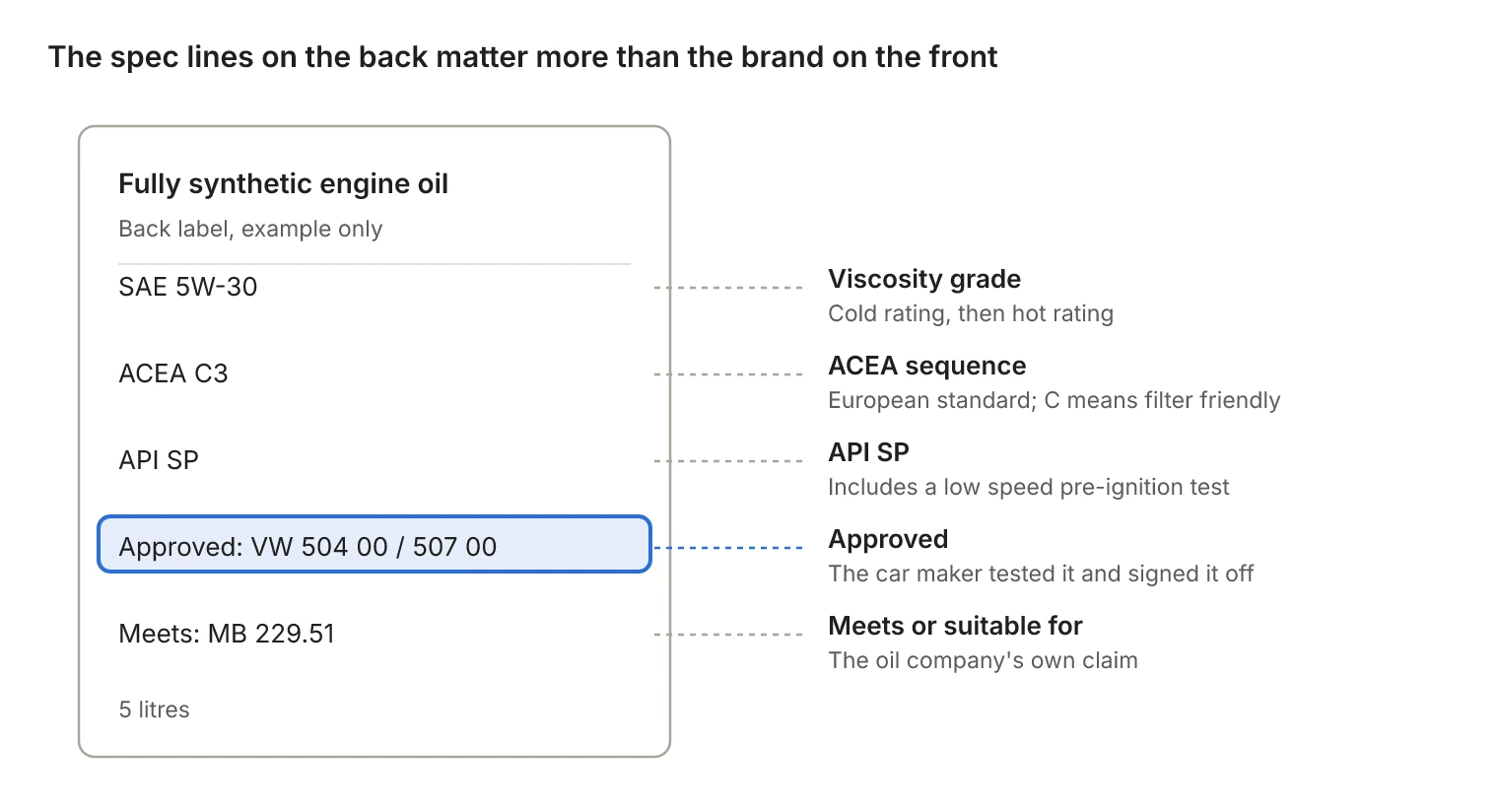
Plenty of self-declared oils are fine, and VLS, the UK body that checks oil claims, says so. But Lubrizol's lab work found some "suitable for use" oils with problems ranging from piston failure to sludge build-up. Lubrizol also notes that VLS has looked into more than 120 cases since 2013, most often over oils not matching the specs on the label.
If your car is under warranty, or you're about to take it on track, an approved oil is the safer buy.
Engines where the wrong oil gets expensive
Some modern engines run their timing belt inside the engine oil, a design known as a wet belt. With the wrong oil the belt can deteriorate and shed debris, which clogs the oil strainer and can wreck the engine. Two families account for a lot of UK cars.
Wet belt engine | Found in | Spec to look for | Usual grade |
|---|---|---|---|
Ford 1.0 EcoBoost (three cylinder) | Ford models | Ford WSS-M2C948-B | 5W-20 |
Stellantis 1.2 PureTech (EB2) | Peugeot, Citroën, Vauxhall, Fiat, Jeep and DS models | Stellantis FPW 9.55535/03 | 5W-30 |
Ford 1.0 EcoBoost
Ford wrote a spec specifically for its three cylinder 1.0 EcoBoost: WSS-M2C948-B, usually met by a 5W-20 oil such as Mobil Super 3000 Formula F. A generic 5W-30 off the shelf doesn't carry it. Later engines may list a different Ford spec, so check your handbook rather than assuming.
Stellantis 1.2 PureTech
This engine is fitted to many Peugeot, Citroën, Vauxhall, Fiat, Jeep and DS models. Stellantis first recommended a 0W-20, then reversed course after belt failures and mandated a 5W-30 meeting FPW 9.55535/03.
Oil blender MPM says the new spec is now required for all 1.2 PureTech EB2 engines except the EB2LT versions. It also warns that service books and oil tags may still show the old recommendation. If your PureTech's paperwork says 0W-20, check the current spec before you buy anything.
The UK watchdog VLS checked twelve oils claiming this spec. Most claims stood up, but one marketer withdrew its claim when asked for proof. For a wet belt engine, buy a brand you recognise with the approval printed on the label.
Fully synthetic vs semi synthetic
Once you know the spec, this choice is usually made for you. Castrol says more and more car makers now recommend fully synthetic oil, and newer specs such as VW 508 00 call for it outright.
- Fully synthetic oil resists heat and oxidation better and lasts longer between changes, according to Kwik Fit.
- Semi synthetic is a blend of mineral and synthetic base oils, and it costs less.
- Switching between the two does no harm, as long as the grade and spec match your handbook.
- High mileage oils are aimed at engines past roughly 100,000 miles.
For track days, go fully synthetic for its better resistance to heat.
Frequently Asked Questions
Can I use 5W-30 instead of 0W-30?
Usually, yes. Both are 30 grades and behave almost the same once warm, so the deciding factor is the spec. If the 5W-30 carries the approval your handbook lists, you're fine.
Can I use 0W-20 instead of 5W-30?
No, not unless your handbook lists 0W-20 for your engine. It has a thinner hot film, and VW's 0W-20 specs are explicitly not backwards compatible with older engines.
Can I top up with a different brand?
Yes, as long as it has the same grade and spec as the oil already in the engine. Brand matters far less than the code on the label.
How often should I check my oil?
Castrol suggests at least every two weeks and before any long journey. Add before and during every track day to that list.
How often should I change my oil?
Follow the interval in your handbook, which can range from fixed yearly changes to long life schedules. Castrol's rough guide is every 5,000 to 7,500 miles, while VW's 508 00 long life oils can stay in for up to two years or 30,000 km. If you drive on track, change it sooner.