Book a track day at Donington Park and the listing will say GP or National. The two layouts share most of the lap. The difference comes after Starkey's Straight, where the Grand Prix circuit adds the Melbourne Loop. This guide covers what the loop adds, how to drive it, and how overtaking changes between the two.
We're at Donington ourselves on Monday 23 November, on the National circuit with OpenTrack, so we'll be driving the Melbourne Loop ourselves. If you're booked on the same day, come and say hello.
GP and National at a glance
Grand Prix | National | |
|---|---|---|
Length | 4.02 km (2.50 miles) | 3.15 km (1.96 miles) |
Turns | 12 | 10 |
After Starkey's Straight | Fogarty Esses, Melbourne Hairpin, Goddards | Roberts |
Used for | Grand Prix events and some track days | Most other events, including many track days |
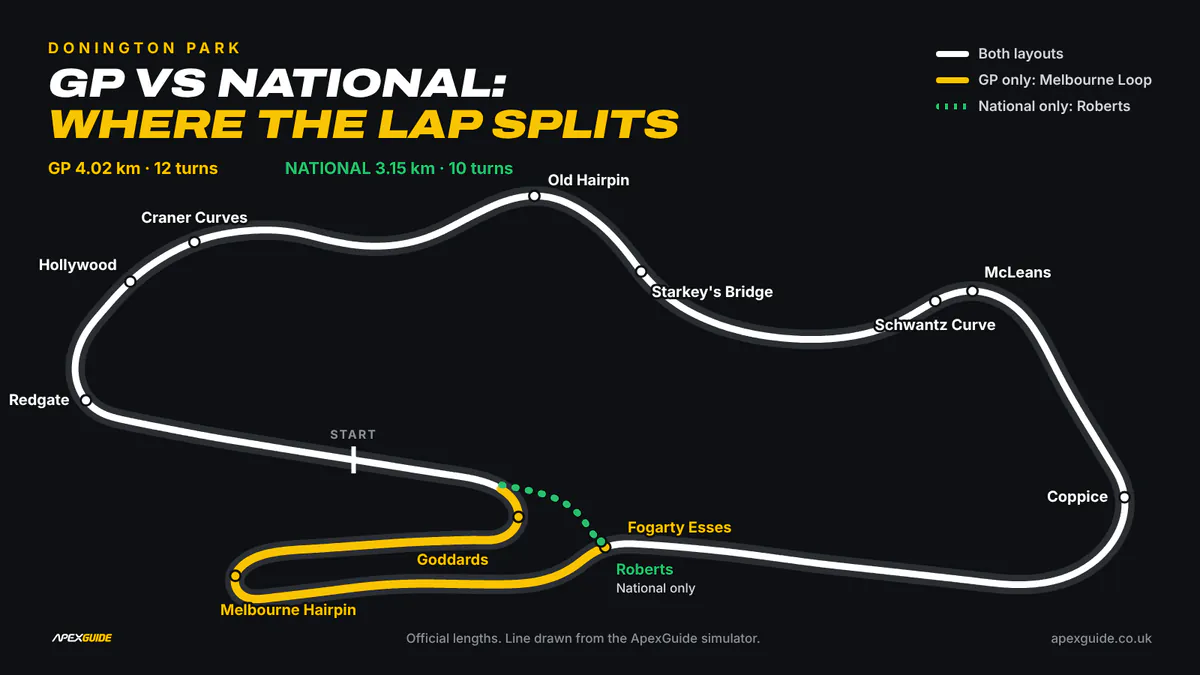
Where the two layouts split
Both laps are the same from the start line to the end of Starkey's Straight. You go through Redgate, Hollywood and the drop down Craner Curves to the Old Hairpin, then climb past Starkey's Bridge, Schwantz Curve and McLeans to Coppice. Coppice leads onto Starkey's Straight, the fastest part of the lap.
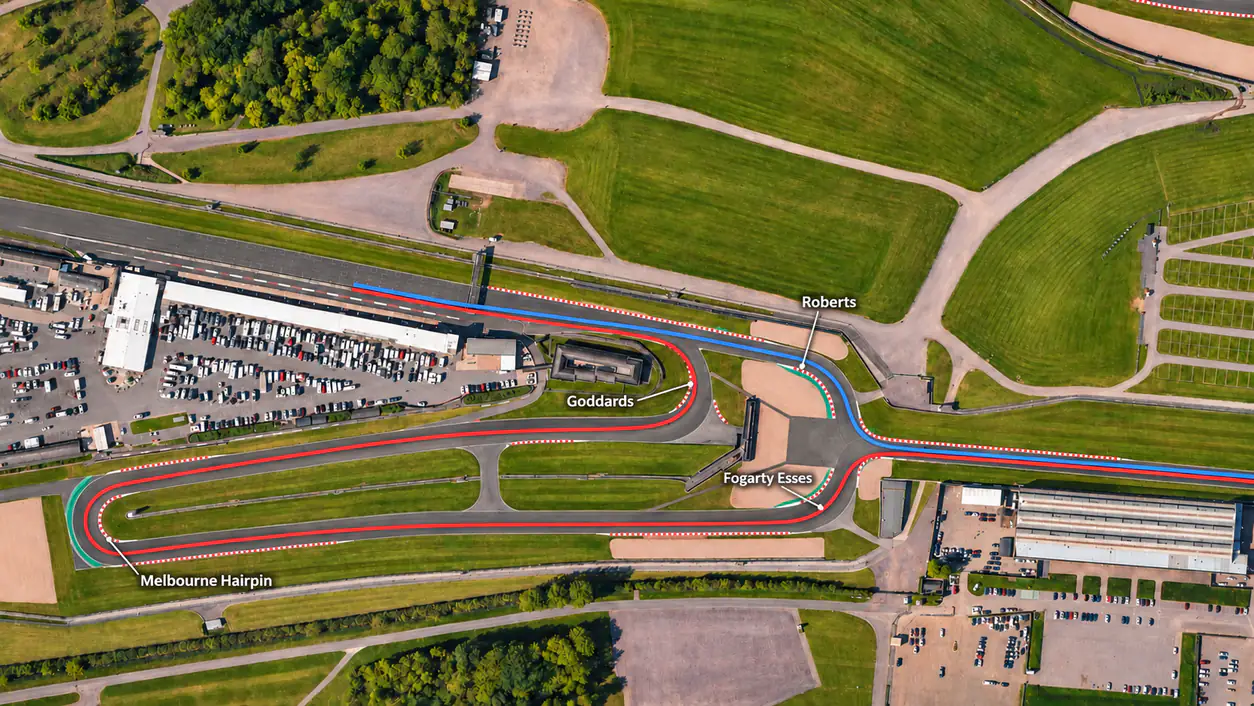
At the end of that straight the layouts go different ways. The National turns right at Roberts and heads straight back to the start-finish straight. The GP turns left into the Fogarty Esses, runs down to the Melbourne Hairpin, then comes back up to Goddards before joining the same start-finish straight.
The loop was built in 1985 so the circuit could host motorcycle Grands Prix, and the full GP layout has been used since 1986. The shorter version kept the National name and is still the layout most events use.
What the Melbourne Loop adds
On the racing line, the GP section from the Esses to the exit of Goddards is about 930 metres. On the National, the same part of the lap is about 150 metres through Roberts.
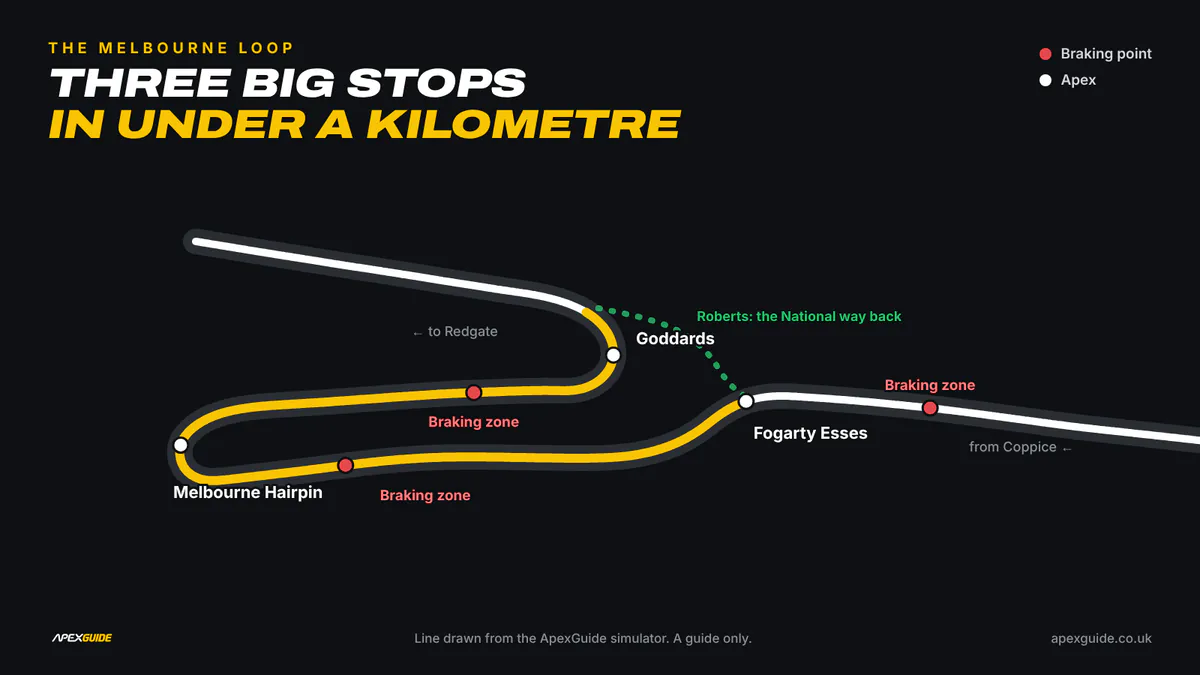
The extra distance matters less than the extra braking. The GP adds three big stops in under a kilometre:
- Fogarty Esses. A hard stop straight off the fastest point of the lap, into a left-right chicane.
- Melbourne Hairpin. A downhill stop into a tight right hairpin.
- Goddards. One more stop for the tight left hairpin back onto the start-finish straight.
Melbourne and Goddards are the two slowest corners on the GP lap. The loop is about a quarter of the lap distance but takes just over a third of the lap time on our reference lap.
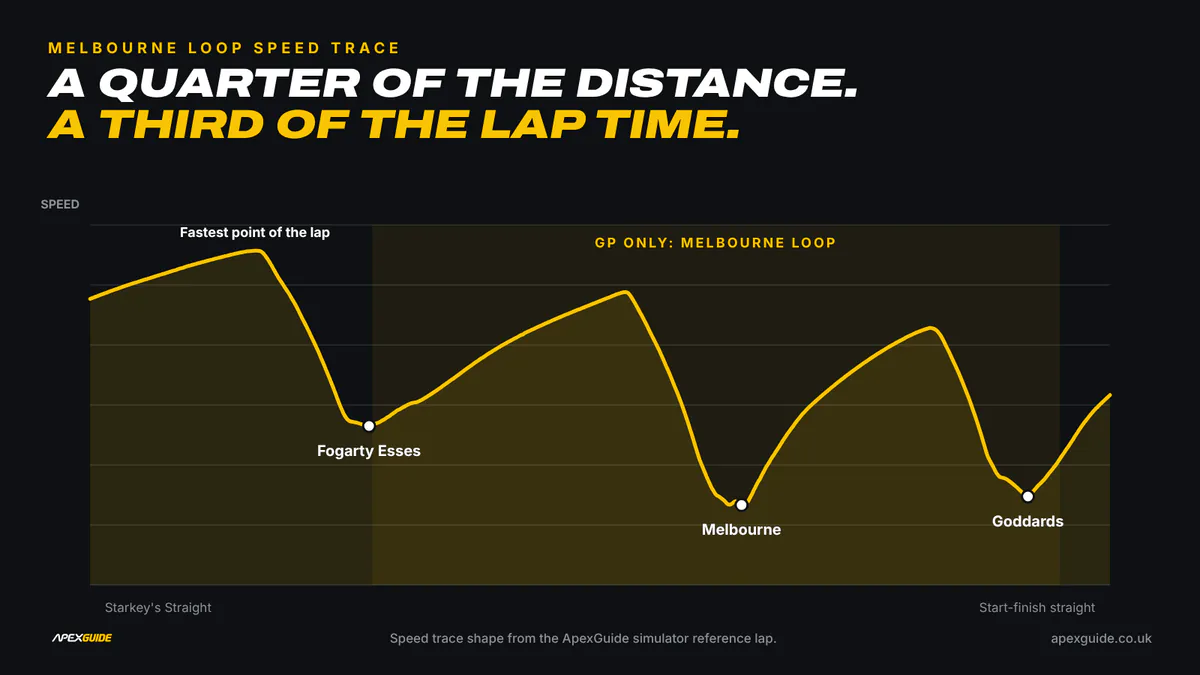
The trace comes from the reference lap in the ApexGuide simulator. Use it to see where the big stops are. Your own braking points depend on your car, tyres and the conditions.
How to drive the Melbourne Loop
Fogarty Esses
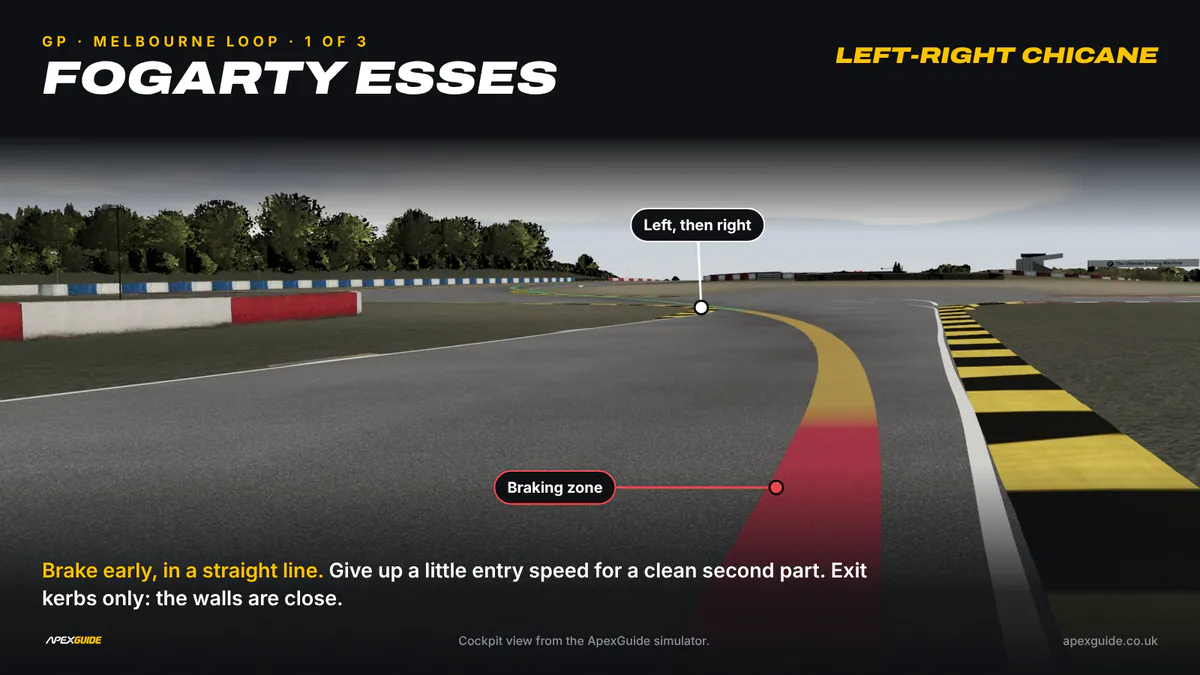
You arrive straight off the fastest point of the lap, so this is the biggest stop of the three. Brake early and in a straight line, and give away a little entry speed so you can take the second part of the chicane cleanly. Use the exit kerbs only. The walls are close here, so a mistake costs more than it would elsewhere.
Melbourne Hairpin
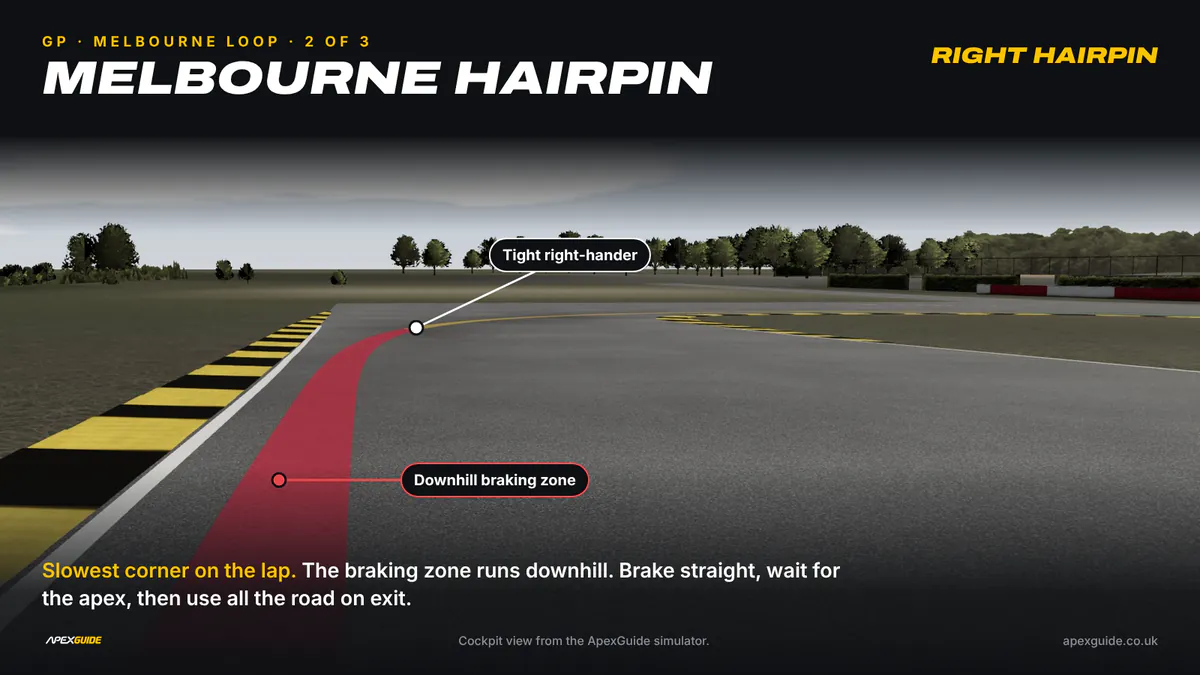
The slowest corner on the lap. The braking zone runs slightly downhill, which takes weight off the rear of the car as you brake. Brake in a straight line, wait for the apex rather than turning in early, then let the car use all the road on the way out.
Goddards
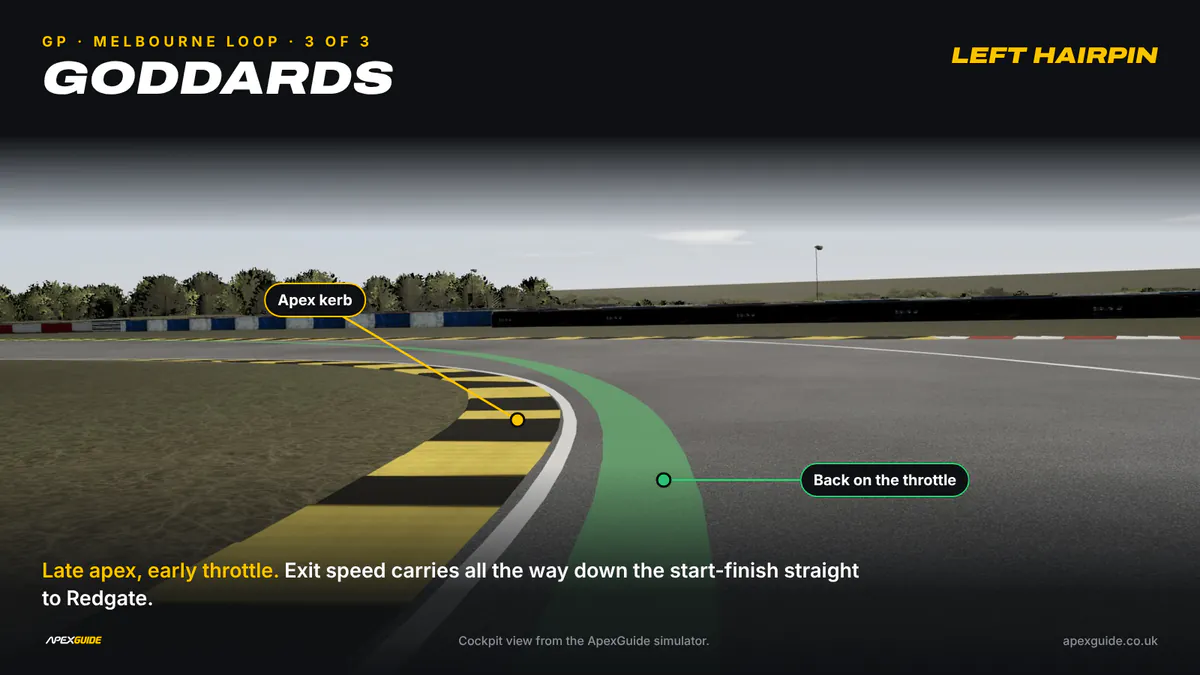
A tight left hairpin that takes you onto the start-finish straight. Exit speed matters more than entry speed here, because it carries all the way down to Redgate. Aim for a late apex and get back on the throttle early.
Roberts (National only)
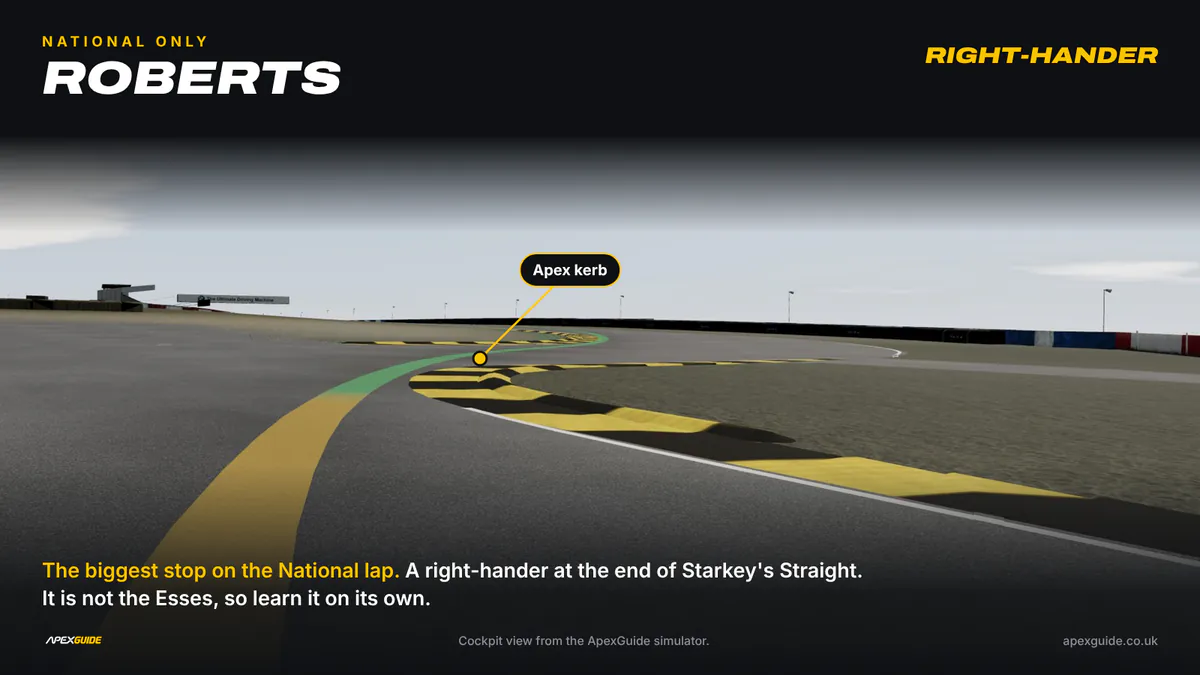
On the National, Roberts is the one big stop at the end of Starkey's Straight, a right-hander taken from top speed. It isn't the same corner as the Esses, so don't learn one and expect the other. If your day uses both layouts, you need to know both.
Overtaking on each layout
Most UK track days only allow overtaking on the straights, and many ask the car in front to signal you past. Your organiser's briefing sets the exact rules, so listen to it even if you've driven Donington before.
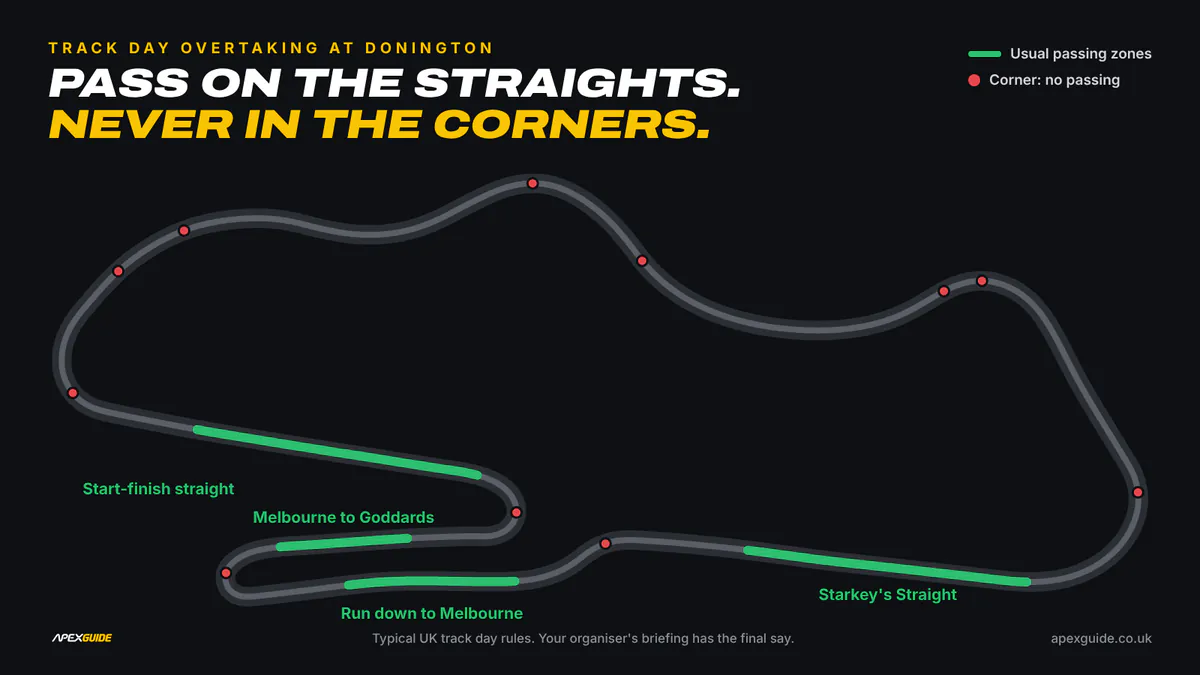
At Donington, the usual places to pass are:
- Starkey's Straight, both layouts. The longest straight on the circuit. It leads into the biggest stop of the lap, so finish any pass well before the braking zone for the Esses or Roberts.
- The start-finish straight, both layouts. From the exit of Goddards or Roberts to the braking zone for Redgate.
- The run down to Melbourne, GP only. The straight after the Esses.
- Melbourne back up to Goddards, GP only. A shorter straight, so only pass if the car ahead lets you by early.
Don't try to pass through Craner Curves or on the climb to McLeans and Coppice. They are fast, partly blind, and nobody expects a car alongside there. On the National the lap is shorter, so you'll come up behind the same cars more often. Be patient and wait for the straight.
Donington track days this winter
- Monday 23 November: National circuit. A full day event. We'll be there. See OpenTrack's dates.
- Friday 18 December: GP and National, £169. GP in the morning and National in the afternoon, so you can drive both layouts in one day. See the date.
Prices were checked on 12 November 2026 and can change. For other dates and circuits, use the track day finder.
Learn both layouts before you go
The ApexGuide simulator has both Donington layouts and runs in your browser on a phone or laptop. You can drive the GP lap or drive the National lap, follow the racing line and brake markers, and replay the part of the lap that changes between the two.
Frequently Asked Questions
How do I get to Donington Park?
Donington Park is near Castle Donington, south-east of Derby and next to East Midlands Airport. Use DE74 2BN in your sat nav. From the M1, take junction 24 if you’re coming from the north or 23A if you’re coming from the south. Follow the A453 past the airport, then turn right onto Melbourne Lane for the paddock entrance. Official Donington Park directions
How long is the Donington Park GP circuit?
The GP circuit is 4.02 km (2.50 miles) with 12 turns. The National is 3.15 km (1.96 miles) with 10 turns.
What is the Melbourne Loop?
It's the part of the GP circuit after Starkey's Straight: the Fogarty Esses, the Melbourne Hairpin and Goddards. It was built in 1985, and the National layout leaves it out.
Which Donington layout is better for a first track day?
Either works. The National is shorter, so there is less to learn. The GP has more heavy braking zones, which is good practice but more to remember. Check which layout your day uses before you book.
How do I know which layout my track day uses?
The organiser's listing usually names it. If it only says Donington Park, ask the organiser before you start learning the lap.