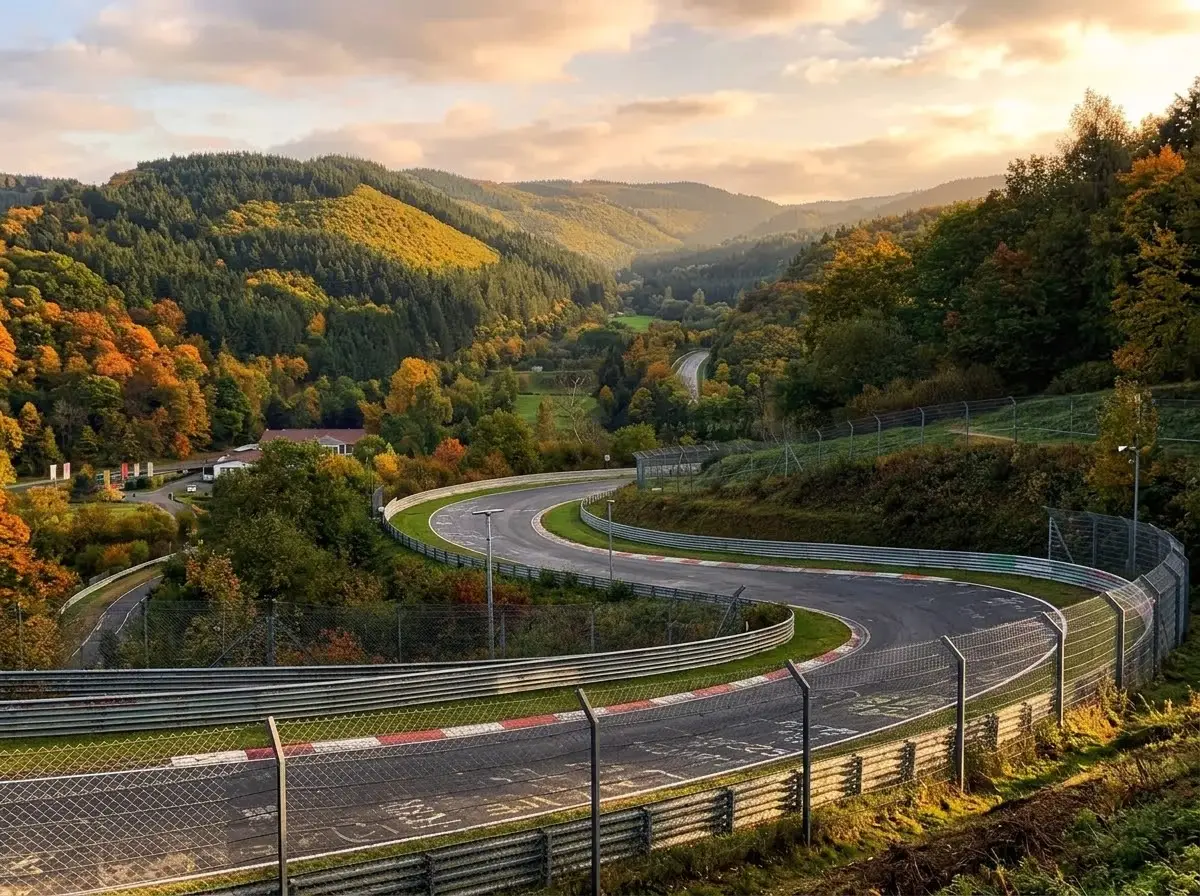
Learn the Nürburgring Nordschleife before your first tourist drive with this guide to the Green Hell, its main sections and planning a visit from the UK. Follow the Tourist reference lap in your browser, then revisit unfamiliar combinations at your own pace. Explore the Nordschleife Tourist lap on your phone, tablet or desktop, with no racing game or sim rig to install.
About the Nürburgring Nordschleife
The Nordschleife runs through Germany’s Eifel region and forms part of the Nürburgring complex. The full circuit measures 20.832 km (approximately 12.94 miles). Its length, changing gradients and succession of partly hidden corners make it a very different learning task from a short circuit.
Known as the Green Hell, or Grüne Hölle, the Nordschleife owes its famous nickname to Sir Jackie Stewart. The wooded surroundings make it spectacular, but its blind crests, compressions and relentless sequence of corners explain why learning it takes patience. The name is part of its appeal; approaching it with respect is part of enjoying the visit.
The Nordschleife and the Nürburgring Grand Prix circuit are different layouts. This guide and the linked viewer cover the Nordschleife Tourist layout, rather than the Grand Prix circuit or a combined endurance-racing configuration.
Do not expect one evening of watching laps to make the route familiar. A useful first goal is recognising the major sections and knowing when an unfamiliar combination is approaching. That leaves more attention available for the road, traffic and instructions when you visit.
Tourist driving and track days are different
Touristenfahrten means tourist driving. The Nürburgring’s current regulations apply German road-traffic rules to these sessions, with overtaking permitted only on the left. Tourist driving is not a race, and the venue explicitly says it is about the experience rather than lap timing.
An organised track day has its own booking conditions, briefing and operating rules. Do not assume that arrangements from a previous track day apply to a tourist session, or that a tourist-driving ticket gives access to a private event.
Before travelling, read the official tourist-driving regulations and check the requirements for your licence, vehicle, documents and equipment. Confirm your insurance position directly with your insurer for the exact activity you plan to undertake.
Travelling on a motorcycle? Under the venue’s tourist-driving regulations dated January 2026, motorcycle participation is limited to the Grand Prix circuit. Do not plan a Nordschleife tourist ride using older videos or advice; check the current activity and eligibility directly with the venue.
Understanding the Tourist layout and lap distance
The full Nordschleife length, a tourist-driving route and an online timed segment are not interchangeable measurements. Access and exit arrangements interrupt the usual tourist-driving experience around Döttinger Höhe, and a simulator may define its start and finish differently from the venue.
ApexGuide’s current Tourist model reports a route of approximately 19.1 km. That describes the viewer’s model and should not replace the official 20.832 km figure for the full circuit. Reference times from different configurations cannot be compared as if they cover an identical lap.
Use the viewer to connect the sections and recognise approaches. For the visit itself, check the official tourist-driving information for current access arrangements, availability and instructions.
Getting to the Nürburgring from the UK
For a trip in your own car, plan the journey in three parts: getting to your UK departure terminal, crossing the Channel, then driving to Nürburg. Allow approximately five hours of driving from Calais to the Nürburgring, before breaks or delays. That estimate is for the continental leg, not the whole journey from home. LeShuttle’s Nürburg travel guide gives the same approximate driving time.
You can cross by car train from Folkestone or choose a ferry sailing to Calais. LeShuttle’s train crossing takes around 35 minutes, but check-in, border procedures, boarding and disembarking add time. Check your operator’s arrival instructions and use a current route planner for the onward journey through France, Belgium and Germany.
For a first visit, consider travelling out the day before you intend to drive the circuit. Leave room for fuel and meal stops rather than planning an arrival that depends on catching the final tourist-driving session. A relaxed overnight stop is a better starting point than trying to learn an unfamiliar circuit at the end of a long journey.
Documents and preparation for UK drivers
Carry your driving licence, passport and vehicle documents. For your own car, bring the V5C; for a hired or leased vehicle, check the VE103 requirement and obtain the owner’s permission. A UK photocard licence normally needs no international driving permit for this route. Paper licences and licences issued in certain territories need separate checks.
Display the appropriate UK vehicle identifier and check equipment requirements for each country you cross. Read the current GOV.UK guidance for driving in the EU and entry requirements before departure. Permission to take a car abroad does not automatically include permission to drive it on the Nordschleife.
Check insurance for the exact activity
Ask your insurer specifically about Nordschleife Touristenfahrten, not simply driving in Germany. Explain whether you are attending tourist driving or an organised track day and request written clarification. Confirm the position on third-party liability, damage to your car, recovery and any circuit-related charges. Check breakdown assistance separately, including how the vehicle would get home if it could not be driven.
Do not treat European road cover, a track-day policy or a rental booking as proof that your planned session is covered. The wording and exclusions of the actual agreement matter. Resolve those questions before booking the trip, particularly if you are taking a financed, leased or hired vehicle.
Build some flexibility into the trip
Check the official tourist-driving calendar before booking accommodation or crossings, then check again before setting off. A published opening window does not guarantee uninterrupted access: weather, incidents and operational changes can affect the day. Leave time for a briefing or instruction, and keep the return journey flexible enough that you are not rushing to fit in a final lap.
How to learn the Nordschleife before you go
You can begin learning the route without owning a racing simulator. ApexGuide runs in your browser and lets you follow a reference lap, review the line and revisit the sections that are difficult to recognise.
Open Explore the Nordschleife Tourist lap and break the task into short sessions:
- Follow one complete lap. Notice the broad sequence without trying to memorise every name or speed.
- Choose a small group of sections. Learn a few connected approaches, then return to them before moving on.
- Identify what comes after the landmark. Recognising a crest or banked corner is useful only if you also prepare for what follows.
- Review the hidden exits. Watch how the view changes as the reference car reaches a rise or finishes a direction change.
- Refresh the uncertain parts. Before travelling, concentrate on sections you still cannot anticipate rather than chasing a remembered lap time.
The lap is simulated. Its speeds, braking zones and racing line are reference information, not instructions for tourist traffic. A racing line across the road does not override the venue’s traffic rules. Use current road position, visibility, conditions and instruction to guide your real driving.
The Nordschleife, section by section
This overview groups the main sections into manageable chunks. It is a learning outline rather than an exhaustive list of every bend. The starting point in a particular video or model may differ, so follow the sequence around the loop instead of relying on the first corner shown.
Tourist access, Antoniusbuche and Tiergarten
Follow the access controls and signs around Döttinger Höhe, then prepare for the opening sequence towards Tiergarten and Hohenrain. Use the viewer to understand how the circuit connects beyond the access area, but follow the real venue’s current instructions. Joining the route is a time to settle in and assess traffic, not accelerate to a reference speed.
Hohenrain, T13 and Hatzenbach
This part of the loop leads into the closely connected Hatzenbach section. Watch several direction changes together rather than studying one apex in isolation. On a first visit, leave enough time to identify the next part of the sequence without relying on an abrupt steering correction.
Hocheichen, Quiddelbacher Höhe and Flugplatz
Study how the road’s changes in height alter your view through this section. A familiar skyline or corner name does not reveal what is currently beyond a crest. Practise recognising the route in the viewer, then keep a generous margin wherever the real road ahead is hidden.
Schwedenkreuz and Aremberg
These are useful sections to learn as a connected approach rather than separate names on a map. Watch the change in rhythm and where preparation for the next corner begins. Avoid allowing confidence in the preceding section to carry you into a bend you have not yet properly identified.
Fuchsröhre and Adenauer Forst
The changing gradient through Fuchsröhre makes the approach to Adenauer Forst worth repeated review. Keep watching beyond the most obvious dip or rise so you understand the combination that follows. Your learning goal is to anticipate the sequence early, leaving room to respond to traffic and conditions.
Metzgesfeld and Kallenhard
Use this part of the lap to practise distinguishing one approach from another. Watch the full shape of each bend and how its exit positions the reference car for the next section. If the route still feels unfamiliar, reduce the amount you study at once and return to the same short sequence.
Wehrseifen, Breidscheid and Ex-Mühle
Follow this combination through to the changing terrain beyond Breidscheid. Notice how frequently you need to move your attention from the corner you are completing to the next approach. Stay within a pace that allows you to recognise the road without feeling pushed into a last-moment decision.
Bergwerk and Kesselchen
Bergwerk leads into the longer section towards Kesselchen. Review the connection, including the bends along the way, rather than treating the whole run as a straight. A clear mental picture of the route is more useful for a first visit than remembering how quickly the reference car accelerates.
Klostertal and the Karussell approach
Keep following the sequence towards the Karussell instead of focusing only on the famous corner ahead. Look for the point at which the approach changes and the remaining turning becomes clear. Give yourself time to prepare so reaching a recognisable landmark does not distract you from the road immediately in front.
Caracciola-Karussell
The concrete banking makes the Karussell one of the easiest landmarks to recognise. Watch its entry, full arc and exit as one section, without assuming another vehicle’s line suits yours. Seek instruction on using the banking and its transitions rather than experimenting at the reference lap’s pace.
Hohe Acht, Wippermann and Eschbach
This part of the lap is best learned in connected pieces. Watch how the road changes direction and where the next section becomes visible after each turn. Resist the temptation to assume that recognising the Karussell means the following corners are familiar too.
Brünnchen and Eiskurve
Recognise the complete sequence through Brünnchen and onwards, not just a viewpoint you remember from online videos. Keep attention on your own route and traffic. A section that looks familiar from outside the car may be much harder to judge from the driving position.
Pflanzgarten and Stefan-Bellof-S
The rises, drops and linked bends here reward careful study of the road beyond each visible landmark. Use the viewer to understand the sequence, not to practise recreating a racing driver’s jumps or pace. Keep enough margin to respond if the real conditions beyond a crest differ from what you expected.
Schwalbenschwanz and Kleines Karussell
Follow the route through Schwalbenschwanz and the smaller banked section before looking ahead to the finish of your drive. Watch the transitions and the position needed for what follows. The lap is not complete yet, so avoid relaxing your attention simply because several major sections are behind you.
Galgenkopf and Döttinger Höhe
Galgenkopf leads towards Döttinger Höhe and the tourist-driving access and exit area. Review the complete corner before concentrating on the road opening beyond it. On the real visit, follow the displayed speeds, controls and exit instructions rather than copying a racing lap that continues along the straight differently.
Preparing for your first tourist drive
Choose recognition over pace. Familiarity takes repeated visits and study. Leave substantial room for corners you cannot yet identify, and consider qualified instruction instead of trying to learn by following another car.
Check current operating information. Tourist access is subject to the venue’s schedule and conditions. Recheck availability before travelling, and do not build your plans around completing a fixed number of uninterrupted laps.
Prepare the vehicle and paperwork. Read the current eligibility rules and confirm your cover before visiting. A vehicle being capable of entering a circuit does not establish what your insurance policy covers.
Keep room for changing conditions. A long lap can contain different levels of grip and visibility. Adjust to what you can actually see rather than assuming the next section matches the last.
Know the safety instructions before entry. Read the official tourist-driving safety guidance, including signals and what to do if there is a problem. Simulator familiarity does not replace knowing the real venue’s procedures.
Frequently asked questions
How long does it take to drive from Calais to the Nürburgring?
Allow approximately five hours of driving from Calais to the Nürburgring, with extra time for breaks, traffic and roadworks. Your journey from the UK also includes reaching the departure terminal, check-in and the Channel crossing. Use a live route planner before travelling and avoid making your first circuit session depend on an optimistic arrival time.
Can I take my UK car to Nürburgring tourist driving?
A UK registration does not by itself establish eligibility. Check the Nürburgring’s current tourist-driving rules for your vehicle, licence and documents, then confirm insurance for the exact activity. If the car is leased, financed or hired, check the agreement and obtain any required permission. Permission for an ordinary European road trip is not permission for circuit use.
What documents should UK drivers take to the Nürburgring?
Bring your passport, driving licence, insurance details and vehicle paperwork. Take the V5C for your own car, or check the VE103 requirements for a hired or leased car. Read the venue’s document requirements as well as the travel rules, and keep booking details available without relying on a mobile signal.
Do UK drivers need an international driving permit for Germany?
A valid UK photocard driving licence normally does not require an international driving permit for a visit to France, Belgium or Germany. Different checks apply to paper licences and licences issued in certain territories. Consult current GOV.UK guidance for your licence type; road-driving entitlement does not replace the Nürburgring’s own participation requirements.
Does my UK car insurance cover Nürburgring tourist driving?
Do not assume it does because your policy includes European driving. Ask your insurer specifically about Nordschleife Touristenfahrten and obtain written clarification of cover and exclusions. Check liability to others, damage to your own car and recovery arrangements. An organised track day is a different activity, so a policy described as track-day insurance is not enough information on its own.
Can I visit the Nürburgring from the UK over a weekend?
A weekend trip can work, but its practicality depends on where you start in the UK, crossing times and the published circuit schedule. For a first visit, allow separate travel and driving time where possible. Build in rest and a margin for closures instead of planning a tight return crossing immediately after your final intended lap.
Are the overtaking rules the same as a UK track day?
Do not assume that a UK organiser’s rules apply. Nürburgring tourist-driving regulations permit overtaking only on the left and apply German road-traffic rules. Read the current official instructions before entering, including the procedures for traffic and incidents. If attending an organised track day instead, follow that event’s briefing and operating rules.
How can I learn the Nordschleife before travelling from the UK?
Use ApexGuide’s free browser viewer to study the Nordschleife Tourist reference lap on your phone, tablet or desktop. A free account is required to continue exploring certain features and tracks. Review short sections repeatedly, then consider qualified instruction for your visit. Learning the sequence is useful preparation; simulated speeds and braking points are not targets for your first real lap.