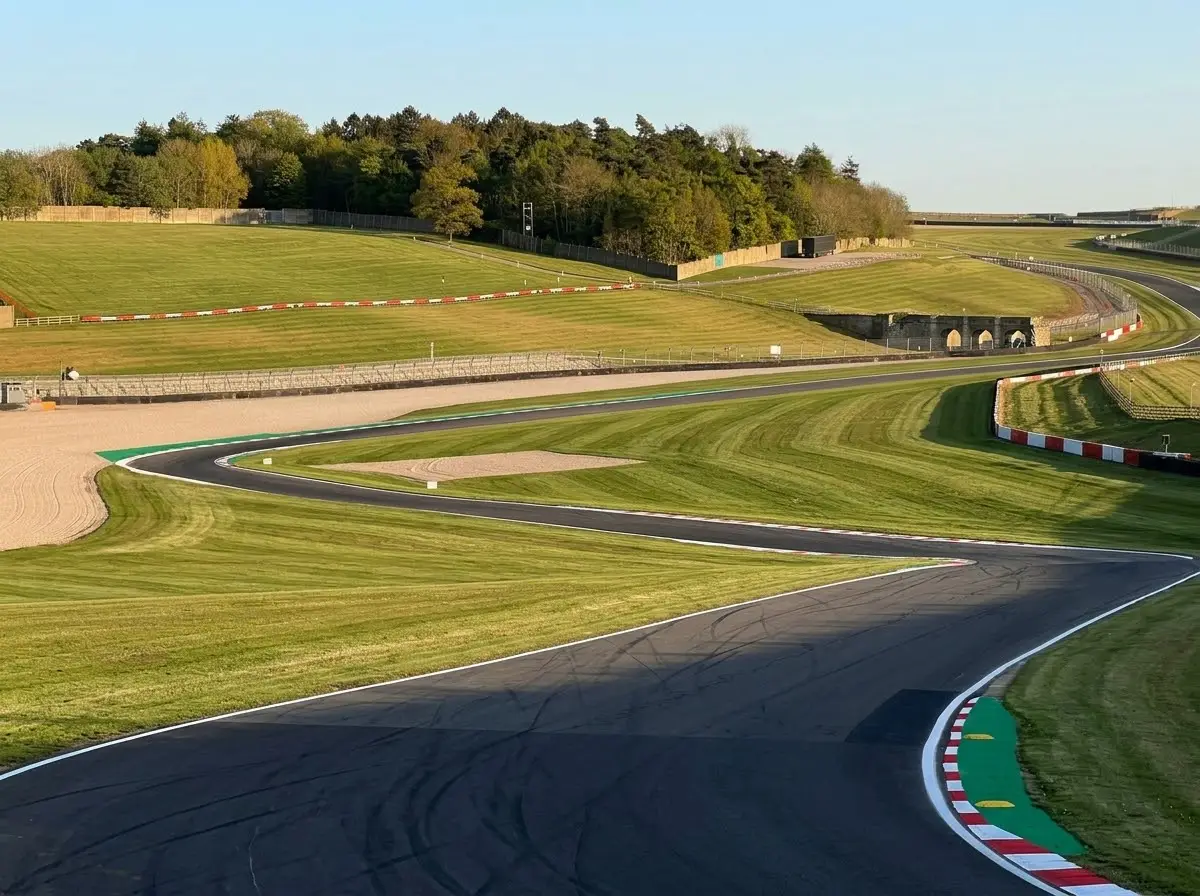
Learn Donington Park before your track day with this guide to the Grand Prix circuit, its corner sequence and the differences from the National layout. Follow a cockpit reference lap in your browser, then revisit the sections that need another look, from Craner Curves to the Melbourne Hairpin. Drive the Donington Park GP lap on your phone or laptop, with no sim rig or racing game to install.
About Donington Park
Donington Park is near Castle Donington in Leicestershire. Its character comes from the way the corners follow the landscape: a descent through Hollywood and Craner Curves, the Old Hairpin at the bottom, then a climb towards McLeans and Coppice.
Those changes in height make a flat circuit map only part of the picture. From the cockpit, the next apex or exit is not always visible when you first approach. Learning the sequence beforehand helps you recognise where you are and prepare for what comes next.
The circuit also has a place in Formula 1 history. Donington hosted the 1993 European Grand Prix, won by Ayrton Senna in changeable conditions. For a first track day, though, familiarity with the next corner is much more useful than comparing yourself with a famous lap.
Donington Park GP and National: which layout to learn
Donington has two main configurations. The Grand Prix circuit is 4.02 km (approximately 2.49 miles), with 12 corners. The National circuit is 3.186 km (approximately 1.98 miles), with 10 corners. These are the venue’s published layout figures; a viewer may group several bends into one named section.
Both layouts share the opening lap from Redgate through Craner Curves, the Old Hairpin, McLeans and Coppice. The important difference comes at the end of Starkey’s Straight.
On the GP layout, the Fogarty Esses lead into the Melbourne loop, followed by the Melbourne Hairpin and Goddards. The National layout uses the Roberts chicane to return to the start-finish straight, leaving out the longer loop.
Check your organiser’s booking page and joining instructions before choosing what to practise. This guide’s cockpit link opens the GP layout. You can use it to study the shared opening section for a National event, but you must learn the different final chicane separately.
Donington Park circuit map
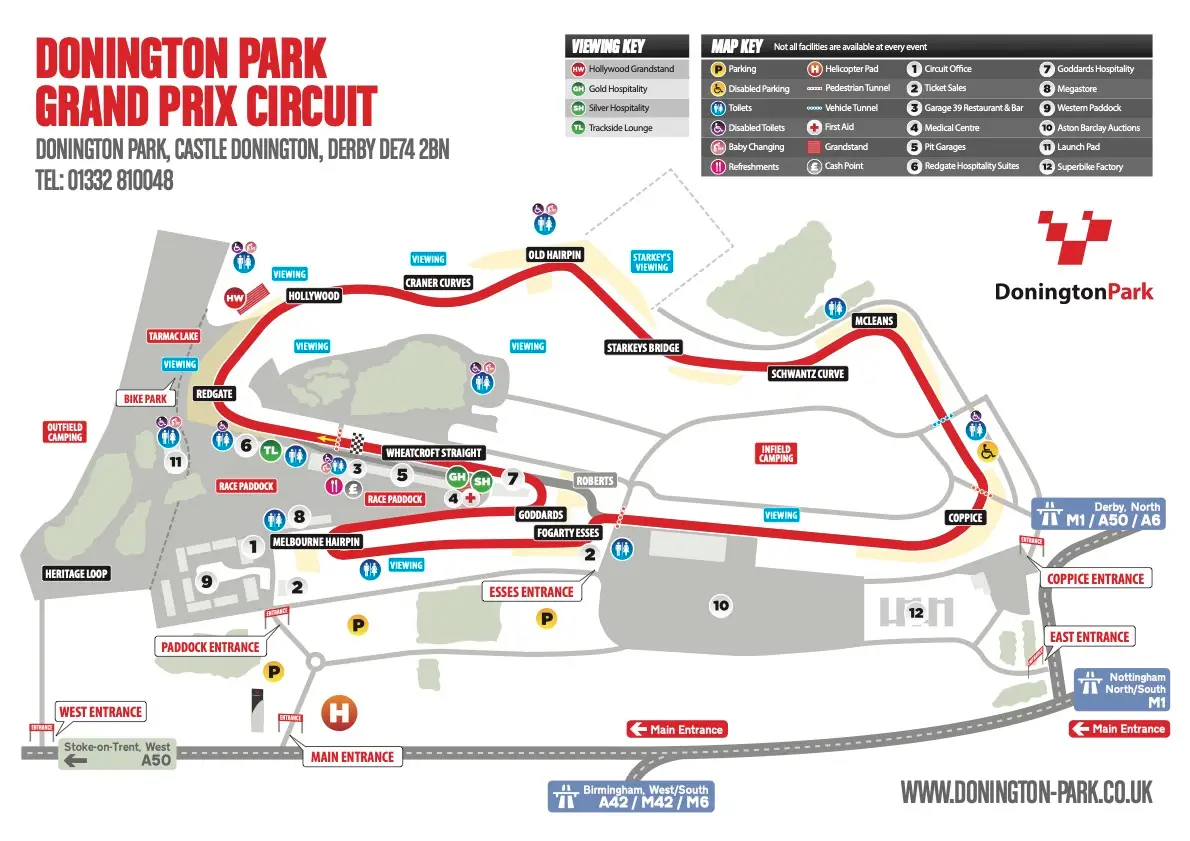
Grand Prix circuit map. Source: Donington Park’s official circuit layouts.
Find the start-finish straight first, then trace the lap through the downhill section and back towards Coppice. The extension containing Melbourne Hairpin identifies the GP route. Compare this with the map in your event information so you do not accidentally learn the wrong finish to the lap.
How to learn Donington before your track day
You do not need a gaming PC, steering wheel or racing simulator to start learning Donington. ApexGuide’s browser viewer shows a reference lap, racing line and corner information so you can study the circuit in short sessions.
Open Drive the Donington Park GP lap and work through this routine:
- Watch a complete lap. Notice the downhill opening section, uphill middle and slower GP finish before concentrating on details.
- Learn the corner order. Try naming the next section before the car reaches it. Redgate, Craner Curves and the Old Hairpin are useful early landmarks.
- Revisit the changes in pace. Compare a flowing section with the approach to a tight hairpin. Watch where preparation begins.
- Study connected corners. Follow how one exit sets up the next approach, particularly through the downhill sequence and the Esses.
- Refresh the lap before travelling. Return to the sections you struggle to recognise rather than trying to memorise every speed figure.
The reference lap comes from a racing simulator. Its speeds and braking zones are examples, not targets for your first session. Your vehicle, tyres, experience and the conditions determine your real braking points.
Riders can use the viewer to learn the layout too, but a car-based reference line does not replace motorcycle-specific instruction. Browser familiarity helps you recognise the circuit; it cannot reproduce the grip, forces or visibility you will experience there.
Donington Park GP corner by corner
Learn the lap as a sequence rather than a collection of isolated apexes. The notes below follow the main named sections in order and highlight what to watch for when reviewing the cockpit lap.
Redgate
Redgate is the right-hander at the end of the start-finish straight. It continues turning longer than the initial approach can suggest, so watch the full corner before deciding where the exit begins. On your first laps, leave a comfortable braking margin and avoid turning in so early that the remaining bend feels unexpectedly tight.
Hollywood
Hollywood begins the descent after Redgate and leads into the Craner Curves sequence. Look at it as preparation for the next direction change rather than an opportunity to use every available bit of road. The useful learning point is where the car needs to be as the descent develops, not how quickly the reference lap gets there.
Craner Curves
Craner Curves combine speed, gradient and changing direction, making this a section to learn as a whole. Watch how the reference line connects the bends and sets up the approach to the Old Hairpin. Build confidence gradually; trying to copy a fast lap before you recognise the sequence can leave you making hurried corrections.
Old Hairpin
Despite its name, the Old Hairpin is a relatively open right-hander rather than a slow, near-180-degree turn. It arrives at the bottom of the descent, so make sure your attention has moved to its approach before finishing Craner Curves. Leave space for the exit and resist treating the corner’s name as an indication of its shape or speed.
Starkey’s Bridge
This left-hand section follows the Old Hairpin as the lap begins to climb. When reviewing the viewer, notice how the previous exit affects the path through here. It is easy to focus on individual corners and miss the connecting sections, but those connections help explain why the reference line uses particular parts of the track.
Schwantz Curve
Schwantz continues the uphill sequence towards McLeans. Keep looking ahead to the next right-hander rather than treating the climb as a straight with nothing to prepare for. Study how the car finishes the left-hand curve and settles for the next braking zone, leaving yourself time to do the same at a comfortable pace.
McLeans
McLeans is a right-hander reached after the climb. The approach gives you less of a complete view than a flat circuit map might suggest, so recognition matters. Watch the point at which the corner opens into view and avoid carrying extra speed simply because you have not yet seen the full bend.
Coppice
Coppice is another right-hander where the rising approach can make the entry difficult to judge on a first visit. Follow the complete shape of the turn and its exit onto Starkey’s Straight. A patient approach gives you time to understand the corner; turning towards an apex you have not properly identified can leave the exit feeling cramped.
Fogarty Esses
At the end of Starkey’s Straight, the GP route passes through the left-right Fogarty Esses. Watch both parts of the chicane together, especially how the first change of direction affects the second. Give yourself enough braking margin to finish the sequence neatly instead of arriving quickly at the first apex with no plan for the next.
Melbourne Hairpin
The Melbourne Hairpin is a tight right-hander approached downhill on the GP extension. It brings a substantial change in pace after the run from the Esses. Recognise the braking area early and keep the downhill approach in mind; a tidy, controlled arrival makes it easier to complete the turn without running short of room.
Goddards
Goddards is the tight left that completes the GP lap and returns you to the start-finish straight. Watch how the reference car finishes turning before building speed away. Avoid rushing the entry because the straight is close: leaving room to complete the corner is more useful than reaching the apex a little faster.
The National layout and Roberts chicane
The National circuit keeps the flowing opening section but ends the lap sooner. After Starkey’s Straight, Roberts provides the return towards the start-finish straight instead of taking you through the Melbourne loop.
Treat Roberts as a separate section to learn. The direction changes, approach and exit are not interchangeable with the GP Esses and hairpins. If you are booked on National, confirm the route during the briefing and use the sighting laps to identify the correct continuation.
First track day at Donington: practical tips
Arrive with time to spare. Follow the organiser’s timetable for signing on, equipment checks, noise testing and the briefing. Learning an unfamiliar circuit is easier when you are not also rushing to join the first session.
Check the event’s noise requirements. Use the limits and testing instructions supplied for your booking. Do not assume that a figure from another Donington event applies to yours.
Make recognition your first-session goal. Identify the route, marshal posts and pit entry. Use the early laps to connect the map and browser view with what you can actually see from your driving position.
Allow for changing grip. Adjust your pace when the weather or surface changes. A braking point that felt comfortable earlier may need a larger margin in different conditions.
Ask for help with specific sections. Tell an instructor if Craner Curves feel rushed or Coppice is difficult to judge. A focused question gives them something useful to work on with you. Follow the briefing’s overtaking rules and build pace only as your understanding improves.
Frequently asked questions
Can I learn Donington Park without a simulator or video game?
Yes. ApexGuide lets you follow a Donington Park GP reference lap in your phone or laptop browser, without buying a racing game or using a steering wheel. You can learn the corner sequence, review approaches and recognise elevation changes before visiting. Use that familiarity alongside the event briefing and instruction on the day.
Is the ApexGuide Donington Park simulator free?
Yes. The ApexGuide Donington Park browser lap viewer is free to use, with a free account required to continue exploring certain features and tracks. You do not need to install a racing game or own a sim rig. The viewer helps you study a reference lap before your track day.
Which Donington Park layout is my track day on?
Check the organiser’s booking page, confirmation email and joining instructions for Grand Prix or National. Both layouts share the opening section, but their final corners differ. The GP circuit includes the Melbourne loop, while National returns through Roberts. If your booking only says Donington Park, ask the organiser before choosing which lap to learn.
What is the difference between Donington GP and National?
Donington’s GP layout continues through the Fogarty Esses to the Melbourne Hairpin and Goddards. The National layout leaves out that extension and returns to the start-finish straight through Roberts chicane. They share the opening corners, including Redgate, Craner Curves, the Old Hairpin, McLeans and Coppice, but need different preparation at the end of the lap.
How long is Donington Park?
Donington Park publishes the Grand Prix circuit as 4.02 km, approximately 2.49 miles, with 12 corners. The National circuit is 3.186 km, approximately 1.98 miles, with 10 corners. Check which configuration your event uses, because the name Donington Park alone does not specify the layout or lap distance.
Where should I brake at Donington Park?
There is no single set of braking points that suits every vehicle and driver at Donington. Review the braking zones in the reference lap to understand the approaches, particularly Redgate, the Fogarty Esses and Melbourne Hairpin. Start conservatively on track and adjust with instruction, allowing for your speed, tyres, vehicle and conditions.
Is Donington Park suitable for a first track day?
Donington can be suitable for a first track day when you choose an event that welcomes beginners and drive within your experience. Its fast sections and changing gradients deserve a patient approach. Learn the correct layout beforehand, use the sighting laps, follow the briefing and take instruction where available rather than chasing a lap time.
What is the hardest corner at Donington Park?
Different sections challenge different drivers. Craner Curves combine speed, descent and changes of direction, while Coppice can be difficult to judge because of its rising approach. On the GP layout, Melbourne Hairpin adds downhill braking into a tight turn. Spend extra time studying whichever section you find hardest to recognise and discuss it with an instructor.