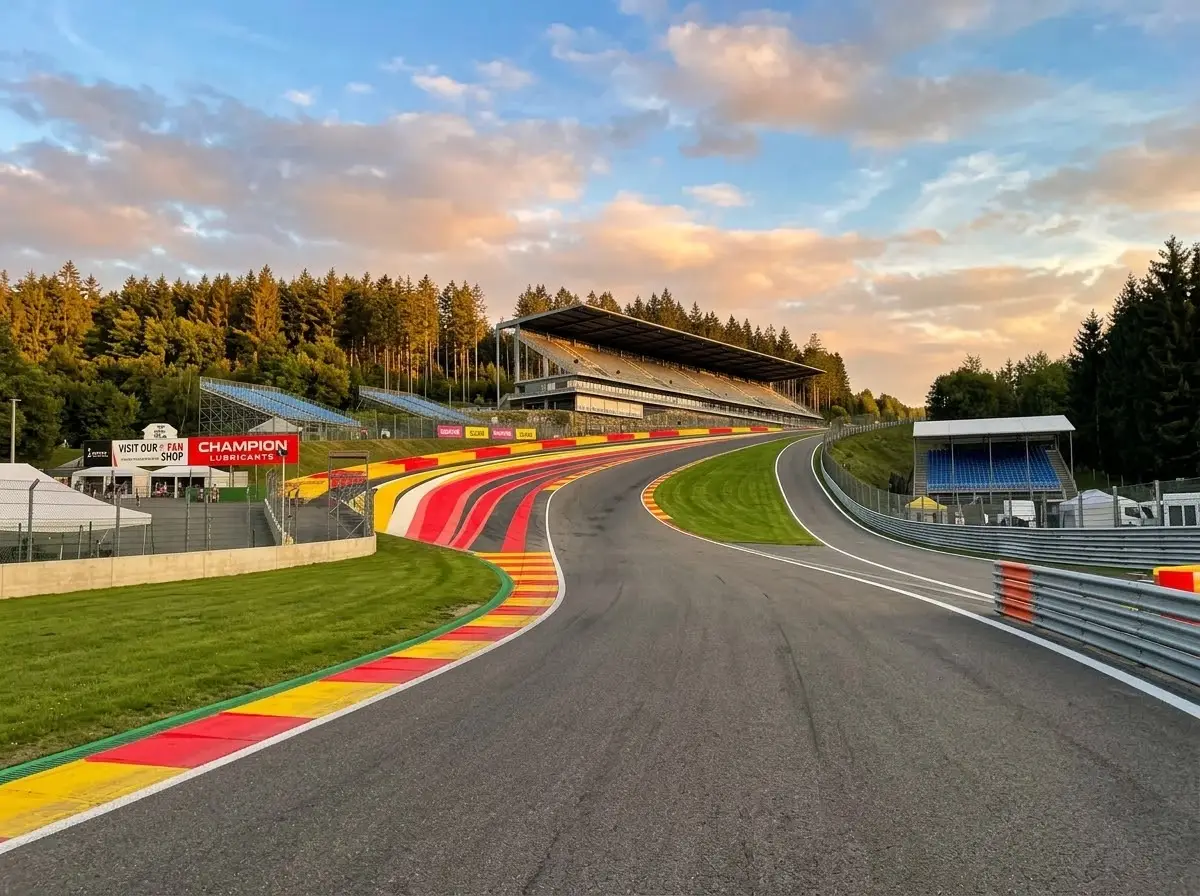
Learn Spa-Francorchamps before your track day with this guide to its layout, corner sequence and changing gradients. Follow a cockpit reference lap in your browser, then revisit the approaches to Eau Rouge, Raidillon, Pouhon and the final chicane at your own pace. Drive the Spa-Francorchamps lap on your phone, tablet or desktop, with no racing game or sim rig to install.
About Spa-Francorchamps
The Circuit de Spa-Francorchamps is in the Belgian Ardennes, near Francorchamps. Its modern Grand Prix layout measures 7.004 km (approximately 4.35 miles) and combines long straights, slow hairpins, fast bends and substantial changes in height.
That variety is what makes preparation useful. A corner that looks straightforward on a map can feel quite different when the road drops away, climbs steeply or hides its exit beyond a crest. Learning the sequence gives you more time to recognise those changes when you arrive.
You do not need to memorise a racing driver’s lap to benefit. Being able to identify the next braking area, distinguish two similarly named sections and anticipate a tightening bend are worthwhile goals for a first visit.
Understanding the Spa circuit layout
Start with La Source, the right-hand hairpin after the main start-finish straight. The lap then descends towards Eau Rouge, climbs through Raidillon and continues along Kemmel towards Les Combes.
The middle section takes you downhill through Bruxelles and towards the double left of Pouhon. Fagnes, Campus and Courbe Paul Frère lead into the run towards Blanchimont. The final right-left chicane brings you back to the main straight.
It helps to divide the lap into three parts: the opening climb and Kemmel Straight, the technical middle section, and the fast return towards the chicane. Learn the transitions between them before trying to remember every individual detail.
For the venue’s current layout and background, see the official Spa-Francorchamps circuit information. Your organiser’s instructions remain the place to check which pit facilities, access arrangements and any event-specific configuration you will use.
How to learn Spa before your track day
ApexGuide lets you study Spa in a browser without buying a racing simulator or installing a game. The cockpit view helps connect the circuit map with what an approaching corner looks like, while the reference line and braking information give you details to revisit.
Open Drive the Spa-Francorchamps lap and use a few short sessions to build familiarity:
- Follow one complete lap. Notice where the circuit rises and falls before concentrating on speeds.
- Learn the main landmarks. Start with La Source, Raidillon, Les Combes, Pouhon and the final chicane, then fill in the sections between them.
- Revisit the blind approaches. Watch what becomes visible as the car reaches a crest, particularly through Raidillon.
- Study connected corners. Follow the whole sequence through Les Combes and Fagnes, rather than looking at a single apex in isolation.
- Refresh the lap before travelling. Focus on recognising what comes next instead of trying to memorise a list of target speeds.
The reference lap comes from a racing simulator. Braking points and speeds depend on the vehicle, tyres and conditions, so use the viewer to understand the layout rather than set targets for your first session.
For motorcycle track days, the broad layout is useful preparation, but a car-based reference line is not riding instruction. Confirm the configuration used for your event and follow your instructor’s advice.
Spa-Francorchamps corner by corner
The notes below follow the main named sections in lap order. Some contain more than one bend, so the number of headings or markers in a viewer is not necessarily the circuit’s official turn count.
La Source
La Source is the tight right-hand hairpin at the end of the main straight. Watch how long the car continues turning before the downhill exit opens up. On your first laps, leave a comfortable braking margin and avoid turning in so early that you run short of room later in the bend.
Eau Rouge
Eau Rouge is the left-hand bend at the bottom of the descent, immediately before the uphill Raidillon sequence. The name is often used for the whole complex, but separating the two helps you understand the route. Study the approach and where it places the car for the climb rather than treating the first bend as a standalone corner.
Raidillon
Raidillon is the steep uphill sequence after Eau Rouge, with a crest that limits your view of what lies beyond. Follow the complete section in the viewer so you understand its direction changes and exit towards Kemmel. Keep a generous margin on your first real laps; whether another vehicle takes it flat out says little about the appropriate pace for yours.
Kemmel Straight and Les Combes
Kemmel gives you time to prepare for the braking area at Les Combes. The right-left sequence leads into another right, commonly identified as Malmedy, so watch the full combination before deciding how the first corner should be approached. Arriving too quickly at the first change of direction can make the rest of the section feel rushed.
Bruxelles
Bruxelles, also known as Rivage, is a long downhill right-hander. Its duration matters: reaching the first visible part of the bend does not mean the turning is finished. Watch how the reference line develops throughout the corner and leave yourself room to complete it without needing a sudden correction.
Speaker Corner
The left after Bruxelles is often called Speaker Corner or the unnamed left. It deserves attention even though the preceding right-hander is more obvious on a map. Look at how the exit from Bruxelles positions the car for this change of direction, then follow the route towards Pouhon.
Pouhon, the Double Gauche
Pouhon is the double left, also labelled Double Gauche. Learn it as one extended sequence and keep watching until the second part and exit are complete. Concentrating only on the first apex can leave you unprepared for how much corner remains, especially while you are still learning the approach.
Fagnes
Fagnes combines a right and a left, calling for a change in rhythm after Pouhon. Study how the first part sets up the second rather than trying to make the first apex as fast as possible. At a comfortable learning pace, you should have time to recognise both changes of direction before accelerating away.
Campus
Campus is part of the right-hand section after Fagnes, before Courbe Paul Frère. Keep your attention on how these bends connect instead of assuming the lap has already opened onto its faster return. Watch the remaining curvature and identify the exit before deciding how much acceleration is appropriate.
Courbe Paul Frère
This right-hand section feeds the run towards Blanchimont. The exit matters because it sets your position for what follows, but a clean exit begins with a controlled approach. Avoid letting the prospect of the faster section ahead distract you from finishing the corner you are still in.
Blanchimont
Blanchimont is a fast left-hand section on the return towards the final chicane. Use the viewer to understand the approach, the amount of turning involved and where the braking area ahead begins to come into view. Build pace gradually rather than assuming a familiar corner name makes it straightforward to drive.
The final chicane
The final right-left chicane, often called the Bus Stop, brings a substantial reduction in speed before the start-finish straight. Watch both direction changes together and give yourself enough braking margin to complete them neatly. Rushing the first part can compromise the second and leave you poorly positioned for the straight.
First track day at Spa: practical tips
Check your arrival arrangements. Read the organiser’s instructions for the entrance, paddock, pit facilities and sign-on location. Allow enough time for the briefing and any required checks rather than assuming every Spa event uses the same arrangements.
Make the sighting laps count. Connect the corners you studied with the view from your actual driving position. Identify marshal posts, pit entry and any restrictions explained in the briefing.
Leave room for changing conditions. On a long circuit, do not assume the grip in the next section matches the last one. Reassess your pace when you encounter damp patches, rain or changing visibility.
Check the noise requirements for your booking. Use the organiser’s current limits and testing instructions. A figure quoted for a different event is not a reliable guide to yours.
Choose a manageable learning goal. In an early session, aim to recognise the next corner without hesitation. Later, work with an instructor on the sections you find difficult, rather than trying to improve every part of a seven-kilometre lap at once.
Keep the reference lap in perspective. The real circuit may have different surfaces, kerbs or run-off arrangements from the simulator model. Follow current signs, marshal instructions and the event briefing, and use the viewer for familiarity rather than as a substitute for them.
Frequently asked questions
Can I learn Spa-Francorchamps without a simulator or video game?
Yes. ApexGuide lets you follow a Spa-Francorchamps reference lap in your phone, tablet or desktop browser, without buying a racing game or owning a sim rig. You can learn the corner sequence and review approaches before visiting. Use this preparation alongside the event briefing, sighting laps and instruction on the day.
Is the ApexGuide Spa simulator free?
Yes. ApexGuide’s Spa-Francorchamps browser lap viewer is free to use, with a free account required to continue exploring certain features and tracks. You do not need specialist gaming equipment or a separate game installation. The viewer helps you study a reference lap and become familiar with the circuit before a track day.
How long is the Spa-Francorchamps circuit?
The modern Spa-Francorchamps Grand Prix circuit is 7.004 km long, approximately 4.35 miles. Its lap includes long straights, tight corners and substantial changes in height. Because there is a lot to remember, it helps to learn the opening section, technical middle and return towards the final chicane separately before connecting them.
What is the difference between Eau Rouge and Raidillon?
Eau Rouge is the left-hand bend at the bottom of the descent after La Source. Raidillon is the steep uphill sequence immediately afterwards, leading over the crest towards Kemmel. The whole complex is often called Eau Rouge, but distinguishing the two names makes the circuit map and corner-by-corner guidance easier to follow.
Where should I brake at Spa-Francorchamps?
There is no universal set of braking points for Spa. Your vehicle, tyres, approach speed, experience and conditions all matter. Use the reference lap to recognise braking areas, particularly La Source, Les Combes and the final chicane, then begin conservatively on track. An instructor can help you establish suitable references for your own vehicle.
Is Spa-Francorchamps suitable for a first track day?
Spa can be an option for a first track day if the organiser welcomes beginners and provides a format suited to your experience. Its long lap, fast sections and blind crests call for patient preparation. Learn the layout, follow the briefing and take instruction where available, with familiarity as your first goal rather than speed.
Can I take Eau Rouge and Raidillon flat out?
You should not assume that you can take Eau Rouge and Raidillon flat out because a racing driver, onboard video or simulator lap does so. The appropriate pace depends on the vehicle, grip, conditions and your experience. Start with a generous margin and work with an instructor rather than treating full throttle as a goal.
What is the hardest corner at Spa-Francorchamps?
Different sections challenge different drivers. Raidillon combines a steep climb with a blind crest, Pouhon requires you to judge an extended double left, and Blanchimont brings speed into the equation. Review whichever approach you find hardest to anticipate, then discuss it with an instructor so your preparation relates to your vehicle and the day’s conditions.